



We asked for a therapist the way people do, in the largest city of every state. Google showed Psychology Today on its first page in 267 of 300 searches. ChatGPT read Psychology Today in almost every answer and handed back individual therapists by name, sometimes with their fees.
Then we visited the 3,393 practice websites those answers lead to. Fewer than half say what a session costs. Here is what we found, what it means for your practice, and the full report with our method.
How We Did It
On October 8, 2026, we asked six questions in the largest city of each of the 50 states. We asked them in four places:
- Google search, with its map pack and AI Overview
- Google Maps
- Google’s AI Mode
- ChatGPT, three times for each question
The questions covered a general search, anxiety, couples counseling, a child, trauma, and online therapy. We typed them the way people search Google, such as “therapist near me,” and asked them the way people ask an assistant. That made 1,750 answers.
Then we fetched every practice website a person would see in those answers, 3,665 in all, and checked what the 3,393 that loaded tell a prospective client. We name no practice or clinician. Every number below comes from this one day of data.
Psychology Today Is on Google’s First Page Almost Every Time
Psychology Today appeared in Google’s top 10 for 267 of 300 searches and ranked first in 119. On “therapist near me,” it was first in 31 of the 50 cities.
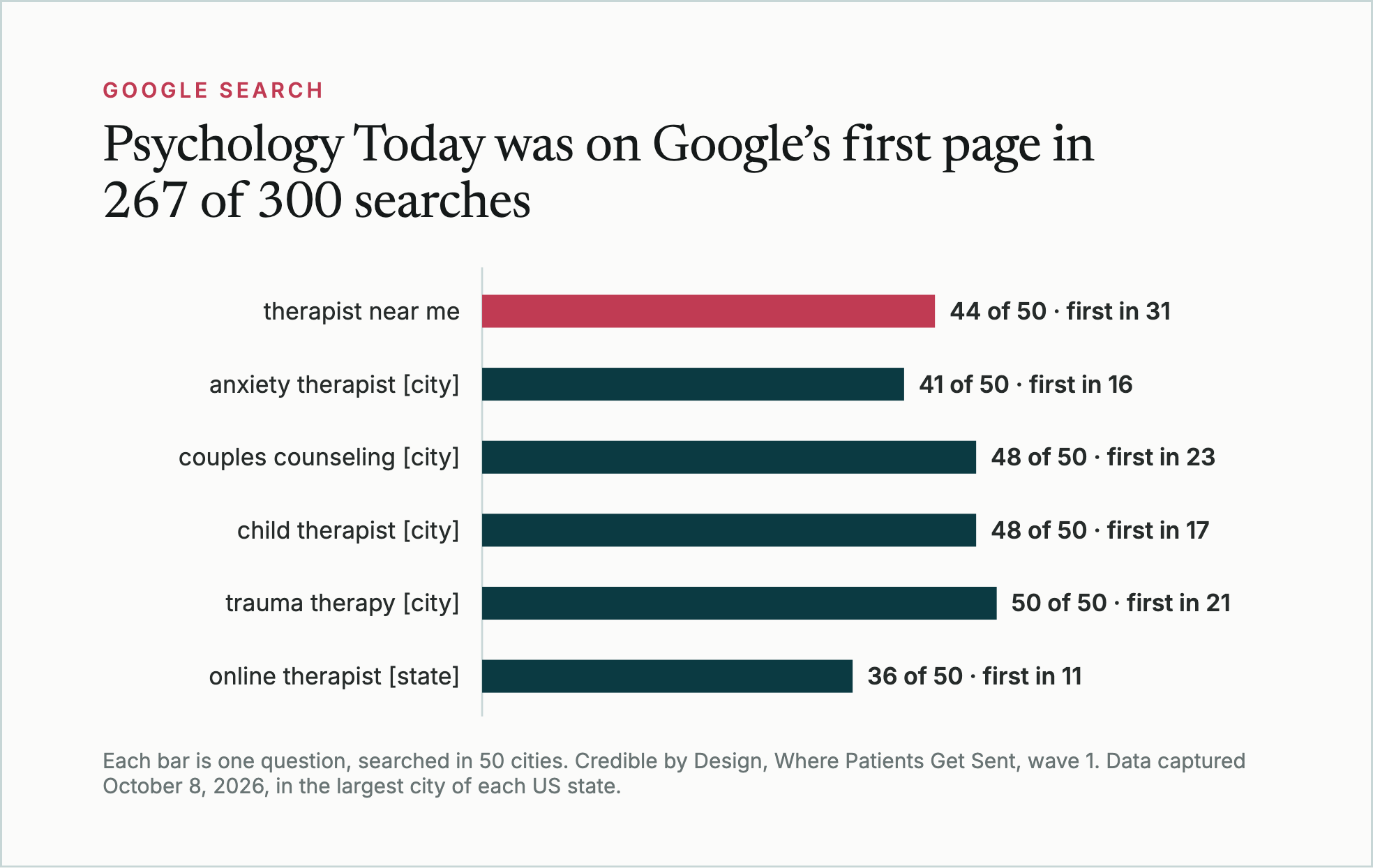
The broadest search left practice websites the least room. On “therapist near me,” directories held 53% of the first page and practice websites 21%. On searches that named a need, such as anxiety, a child, or trauma, practice websites held about half of the first page.
Google’s AI Names Practices Beyond the Map Pack
Google showed an AI Overview on 104 of 300 searches, most often for online therapy (43 of 50). When it named places, it named about four. Only 40% of them were in the map pack on the same page.
Google’s own place pages, the Business Profiles behind its map listings, made up 40% of the sources AI Overviews cited. That makes your Business Profile one of the pages Google’s AI reads about you.
Google’s AI Mode named at least one practice or clinician in 265 of 300 answers. Of the places it showed as cards, 14% were in the map pack for the same search, and 36% were in the first 20 Google Maps results.
ChatGPT Reads Psychology Today and Answers With People
ChatGPT searched the web in all 900 of its answers. Its searches returned Psychology Today in 98% of them, and it cited Psychology Today in 89%.
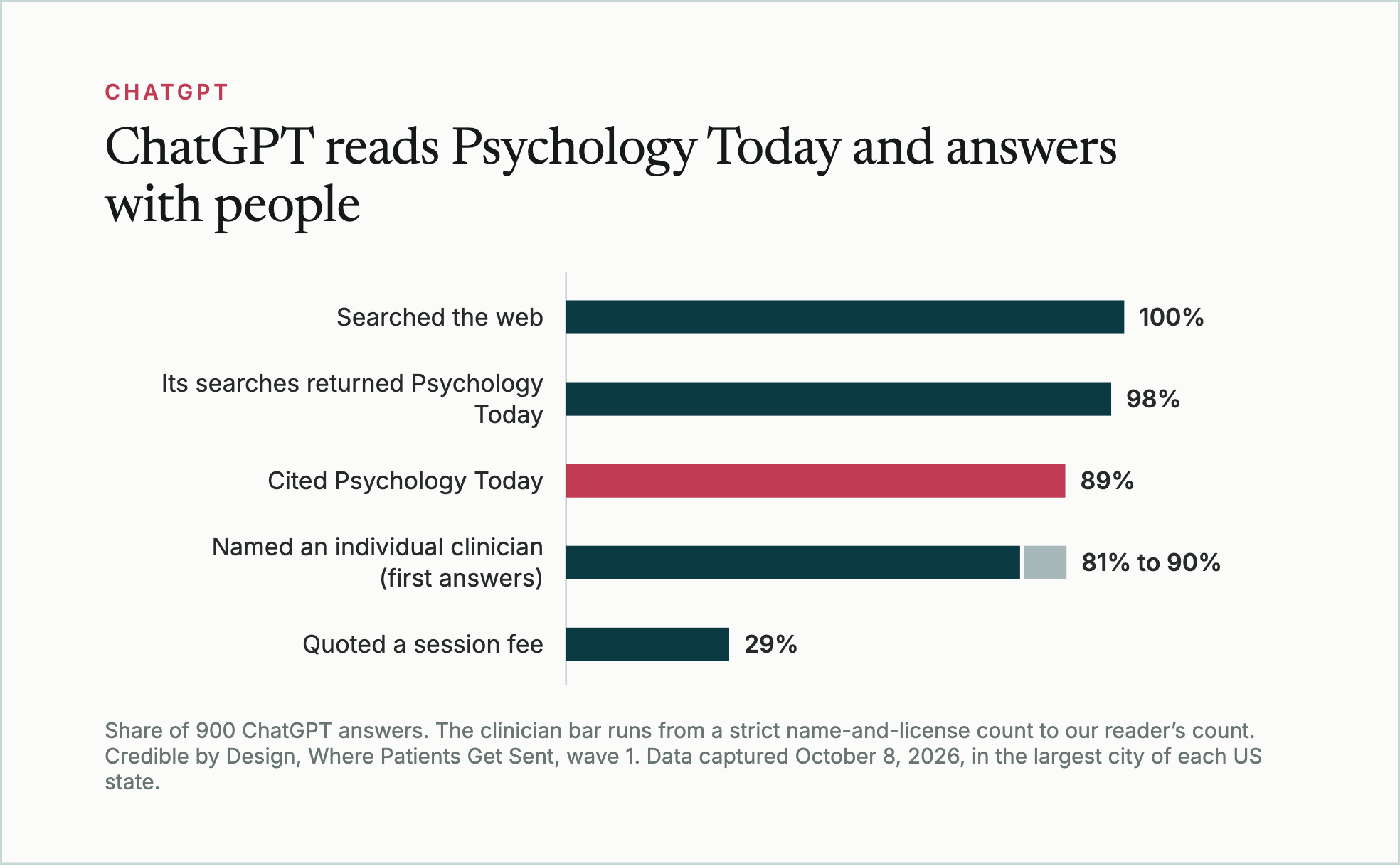
It answered with names. Every first answer named at least one practice or clinician, about six each. Between 81% and 90% of first answers named an individual clinician, depending on how strictly a name is counted.
It also repeated what profiles say, prices included. ChatGPT quoted a session fee in 29% of its answers. In 87% of those, a Psychology Today link followed the fee.
Psychology Today itself was named in only 10% of first answers. ChatGPT turns the directory into a short list of people.
Ask Twice, Get a Different List
We asked ChatGPT each question three times. Only 29% of the businesses it named appeared in all three answers.
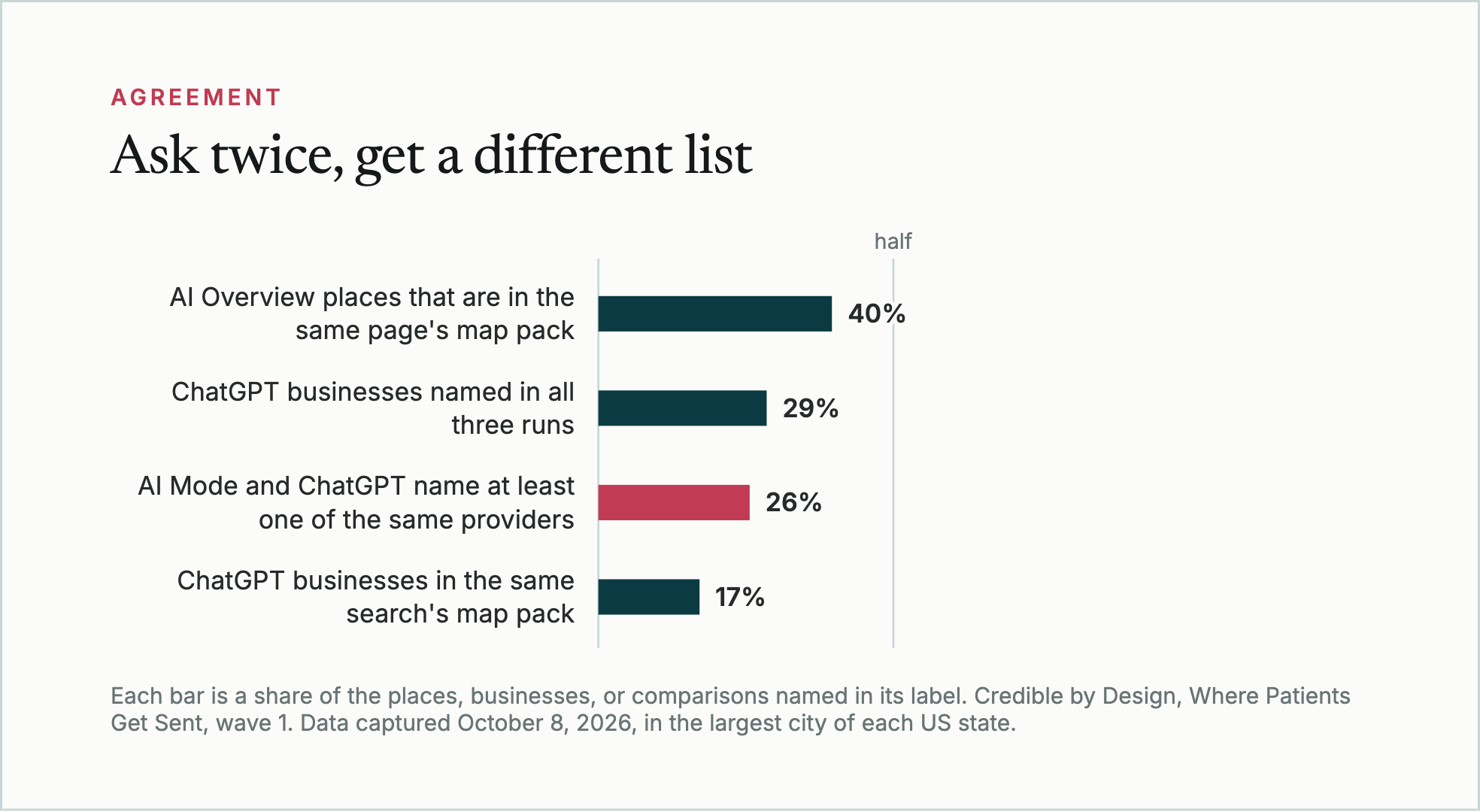
The assistants also differed from each other. Where Google’s AI Mode and ChatGPT both named providers for the same question and city, they shared at least one in 26% of cases. Only 17% of the businesses ChatGPT named were in Google’s map pack for the same search.
Each of these systems builds its own list, and the list changes from one answer to the next.
What the Websites Say
Of the 3,393 practice websites that loaded, most explain how payment works (69%) and mention telehealth (64%). Fewer answer the questions a person asks first.
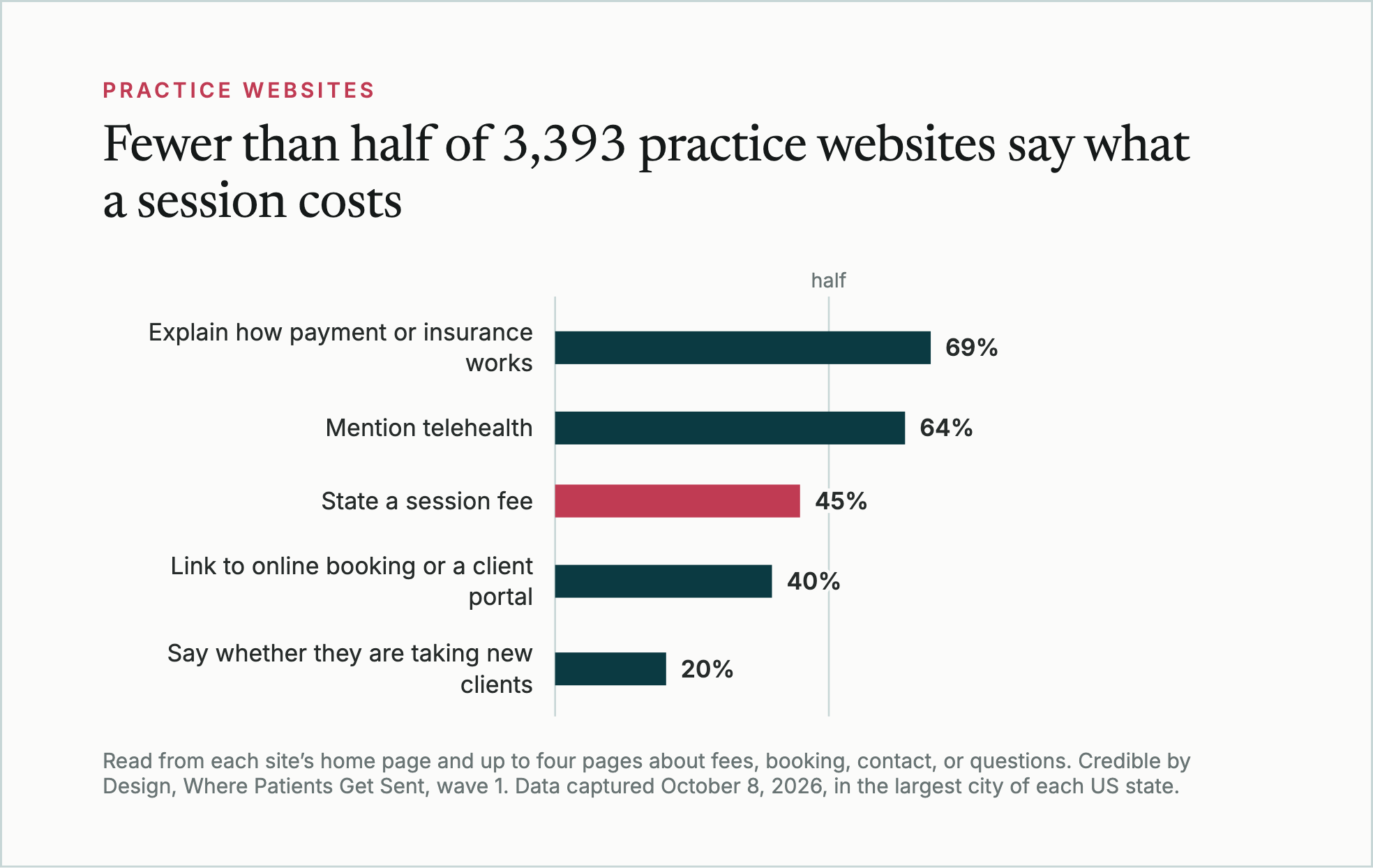
- 45% state what a session costs.
- 40% link to online booking or a client portal.
- 20% say whether they are taking new clients.
Sites in a map pack were more likely to state a fee (53%) than sites that appeared in neither a map pack nor an AI answer (41%). That is a pattern we observed. It does not show that one causes the other.
What This Means for Your Practice
- Treat your Psychology Today profile as part of your website. ChatGPT read it in nearly every answer and repeated what it says, fees included. Keep it current and consistent with your site.
- Keep your Google Business Profile accurate. Google’s own place pages were the largest share of what AI Overviews cited. Check your categories, hours, and services.
- Answer the first questions on your site. Say what a session costs, how payment works, whether you are taking new clients, and how to book.
- Use the words people search with. Name the needs you treat, your city, and online care if you offer it.
- Judge patterns over time. AI answers change from one run to the next, so a single test search tells you little.
Nothing here guarantees that a change gets your practice shown or recommended. It shows what these systems read, and what a person finds when they arrive.
For more on the two profiles, see Psychology Today vs Google Business Profile. For what ChatGPT searches before it names someone, see What ChatGPT Searches to Find a Therapist.
What We Don’t Know
- This is one day of data, from a desktop location in each city, logged out. Results change from week to week.
- We searched the largest city in each state. Rural searches may look different.
- Six questions are a small part of how people ask.
- The ChatGPT app people use may remember them and answer differently.
- We report patterns. Where two things appear together, we make no claim that one causes the other.
We plan to run the same questions in the same cities each quarter and share what changes on our research page. The method, every measure, and how we checked them are in the full report.
See How Your Practice Shows Up
Want to know what someone finds when they look for a practice like yours? Start with a free credibility audit, focused on search and AI answers. We work with therapy and private healthcare practices on their websites and on search engine optimization (SEO). That includes answer engine optimization (AEO) and generative engine optimization (GEO).


