
In our tests, ChatGPT ran a few web searches before it recommended a therapist. It read the results, mostly Psychology Today listings, and named clinicians it found there. When we told it about a problem instead, it gave general self-help and named no one.
We asked three AI assistants six questions, three times each, and recorded every search they ran. Here is what they searched for, what they read, and what it means for your practice.
How We Tested It
On September 29 and October 2, 2026, we sent six questions, word for word, to ChatGPT, Gemini, and Meta AI:
- “anxiety therapist Charlotte NC” (typed the way people search Google)
- “Can you recommend a therapist in Charlotte, NC who helps with anxiety?”
- “I can’t stop overthinking everything and it’s starting to wreck my sleep.”
- “I think I need to talk to someone about my anxiety. Where do I start?”
- “I was just diagnosed with PCOS. What should I change in my diet?”
- “Can you recommend a dietitian who specializes in PCOS and works online?”
Each question ran three times on each assistant, for 54 answers. We gave no instructions, so each assistant decided for itself whether to search. For every answer, we recorded the searches it ran, the pages those searches returned, the pages it cited, and who it named. Every number below comes from these 54 answers.
We used the versions developers build with, each with web search turned on: ChatGPT (gpt-5.4), Gemini (gemini-3.5-flash), and Meta AI (muse-spark-1.3). ChatGPT and Meta AI were given an approximate US location, while Gemini was not. Each question was its own request, with no conversation history and no personal profile. The therapist questions name one city, and the assistants change often. Read what follows as field notes from a small, careful sample.
Two Ways People Ask, Two Different Answers
The biggest difference came from how the question was asked.
| The person asked | Answers | Searched the web | Named a practice or clinician |
|---|---|---|---|
| For a therapist, typed as a search or as a question | 18 | 18 | 18 |
| About a problem: overthinking and poor sleep | 9 | 3 | 0 |
| Where to start with anxiety | 9 | 3 | 0 |
| About a diagnosis: what to eat with PCOS | 9 | 9 | 0 |
| For a PCOS dietitian who works online | 9 | 9 | 9 |
When asked for a therapist, every answer searched and named people. Asked about a problem, the assistants gave general self-help, such as writing worries down, setting aside worry time, and slow breathing. None named a practice.
Asked where to start, all nine answers pointed to a primary care doctor and the 988 Suicide & Crisis Lifeline. Gemini and Meta AI also pointed to Psychology Today in five of their six answers.
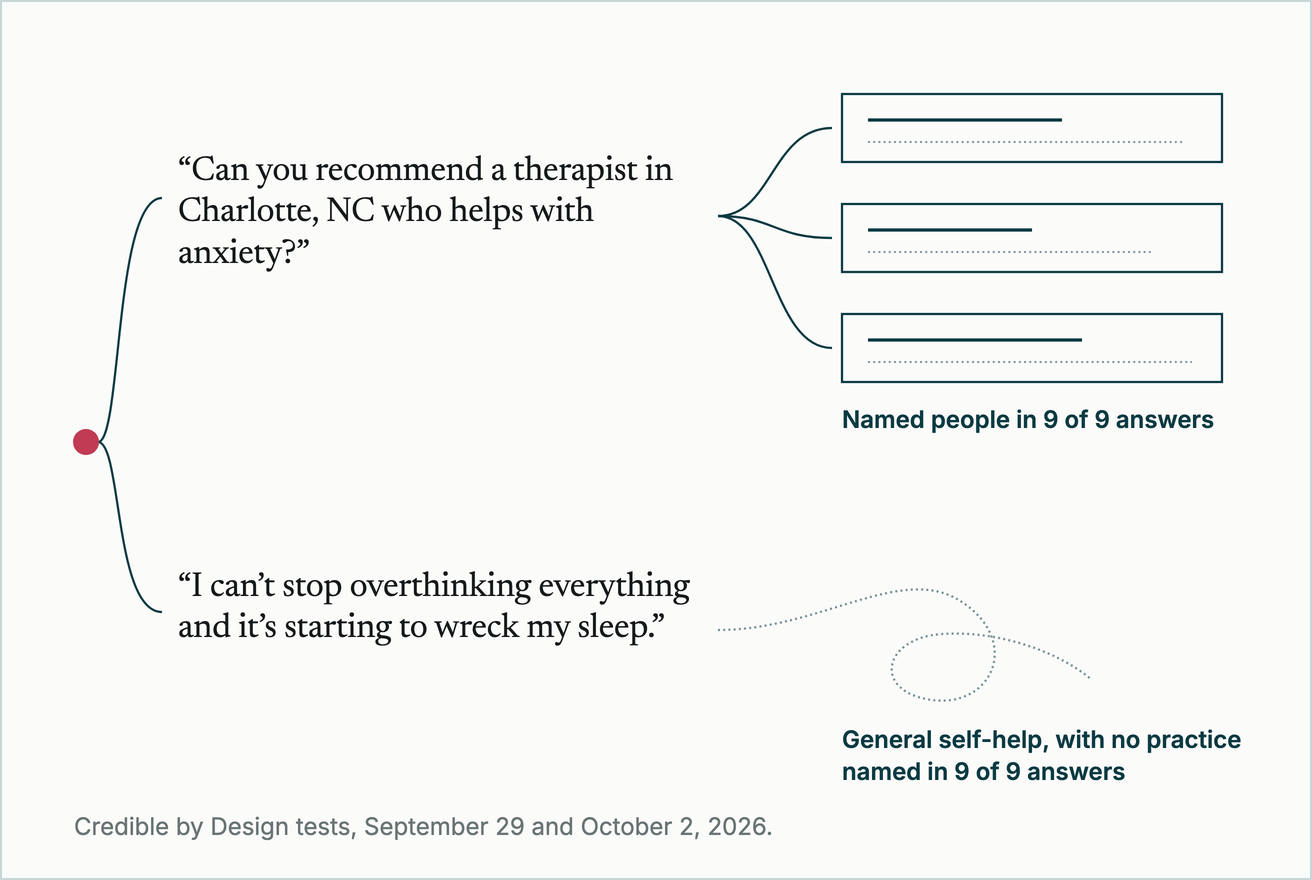
In our tests, practices and clinicians were named only when the question asked for a therapist or a dietitian. Questions about a problem, a diagnosis, or where to start got general help from the assistant itself.
What the Assistant Actually Searches
Google says its AI Overviews and AI Mode may use “query fan-out,” running several related searches to develop one answer. The assistants in our tests did something similar, with one to five searches behind each therapist answer. Here is what those searches looked like.
The searches carried the person’s own words. All 44 searches behind our two therapist questions included the city, and 42 included “anxiety.” The questions mentioned no format or payment, and neither did the searches.
When a question did mention a format, the assistants searched for it under several names. Our dietitian question asked for someone who “works online.” Of its 29 searches, 27 carried online, telehealth, or virtual.
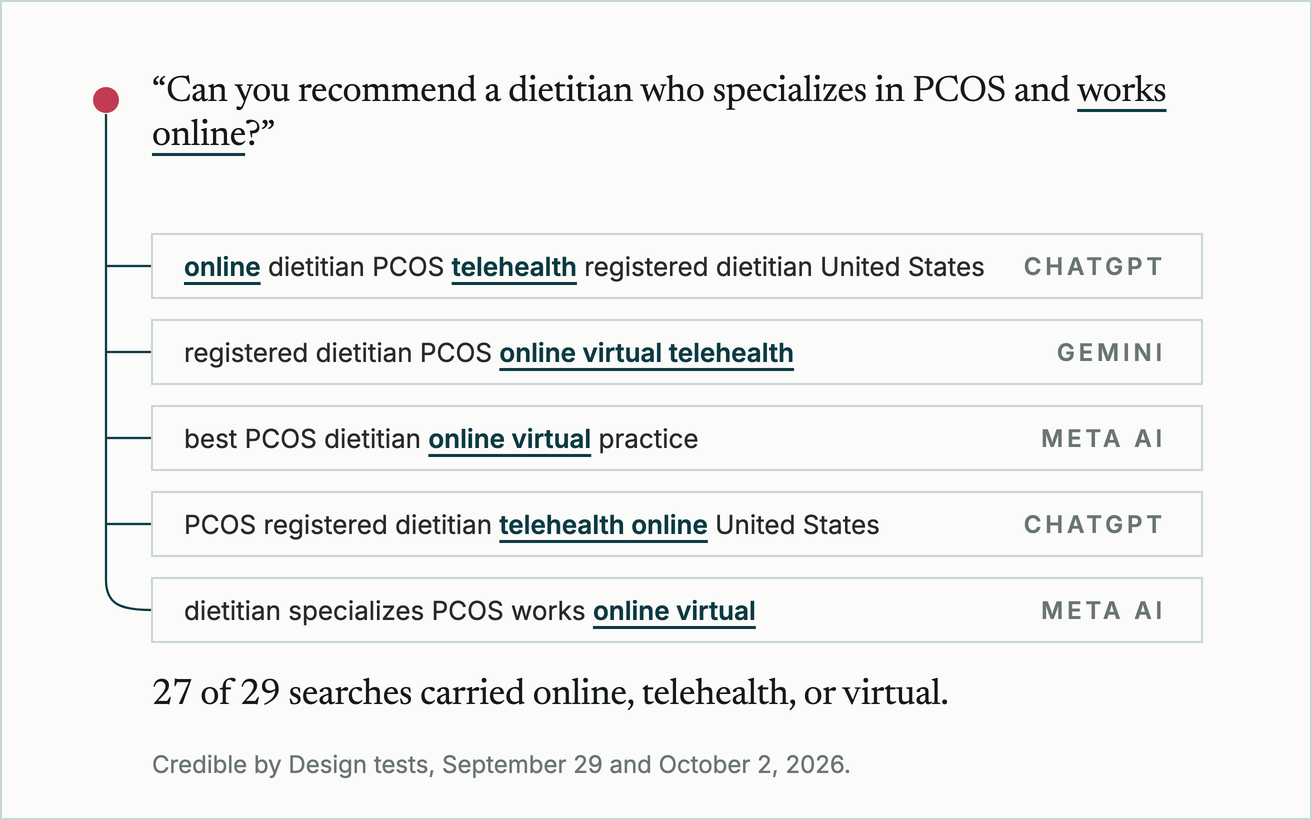
More than a third of therapist searches (16 of 44) added “best” or “top.” Some named a directory outright. A few of the searches, word for word:
- “anxiety therapist Charlotte NC”
- “best anxiety therapy practices Charlotte NC”
- “best anxiety therapists Charlotte North Carolina Psychology Today”
- “Charlotte NC anxiety therapist top rated Zocdoc”
- “online dietitian PCOS telehealth registered dietitian United States”
- “best PCOS dietitian online virtual practice”
So use the words people use. Name your city and the problems you treat. If you see clients online, write “online” and “telehealth,” and name the states where you are licensed. Clear, relatable language makes your practice feel more approachable and trustworthy.
Psychology Today is the front door
Being listed there can make your practice seem more credible and accessible, encouraging potential clients to feel confident in reaching out.
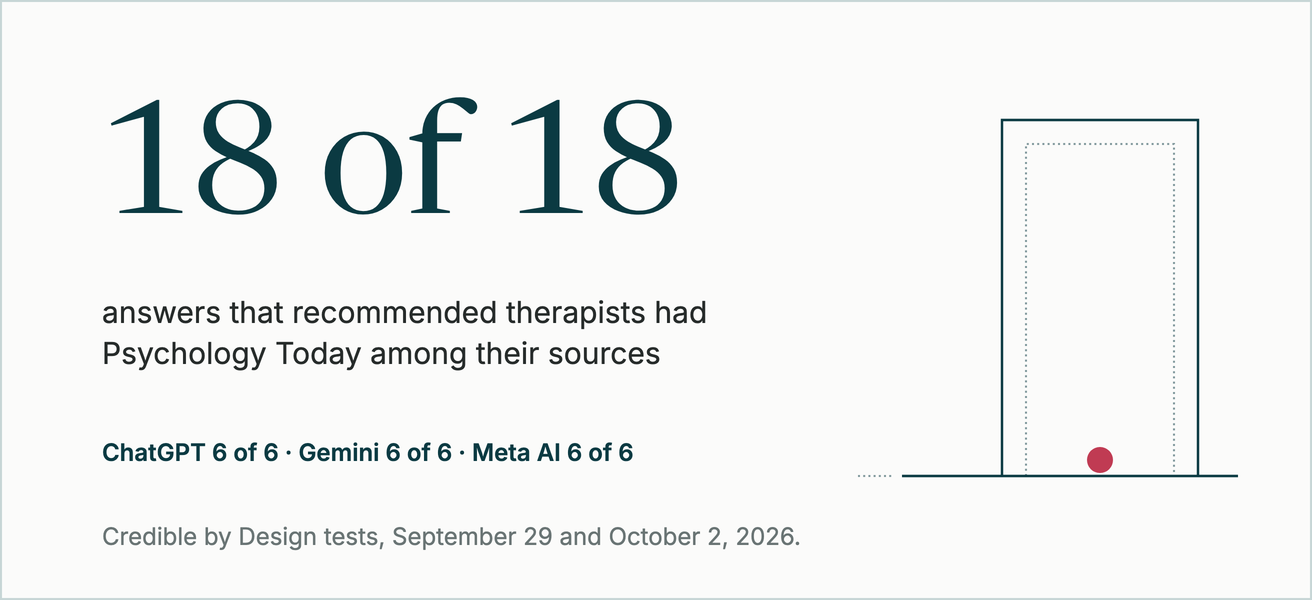
In our tests, Psychology Today was among the sources of all 18 answers that recommended therapists, on all three assistants. It was named in the text of 17 of them.
Two of the assistants also repeated what listings say. Meta AI quoted listing descriptions as block quotes in 4 of its 9 recommendation answers. ChatGPT wrote some version of “her profile says” in 4 of 9. The opening lines of your profile may be the sentence an assistant repeats about you.
That makes your profile worth writing with care, as AI assistants often cite sources like Psychology Today and your practice's website. Optimizing these listings can improve your chances of being recommended, helping your practice stand out in AI-driven search results.
It Looks You Up by Name
Gemini searched for practices and clinicians by name, and most of them appeared in its answers. That was 5 of its 17 therapist searches, and 10 of its 16 dietitian searches.
ChatGPT went looking for practices’ own websites. In 4 of its 6 therapist answers, it added “official” to a search for practices or their sites. One search read “Charlotte NC therapist anxiety official website.” It cited Psychology Today in all 6 answers, and a practice’s own website in 3.
When an assistant checks you, it should find the same facts in every place. That covers your name, your city or states, how you see clients, your fees, and your specialties.
What to Put in Your Profile and on Your Site
- Write your profile’s opening lines to be repeated. Say who you help, the problem, your city (and for online work, your states), how you see clients, and your fees or insurance.
- Make your website say the same things in the same words. Then give it what a profile cannot hold: depth on your specialty, how you work, and what a first session looks like.
- Use the words your clients use. If you work online, say “online” and “telehealth,” and name the states where you are licensed.
- Keep one set of facts everywhere. Gemini looked up practices by name, and ChatGPT and Meta AI repeated what listings said.
- Be ready for the question that asks for someone. In our tests, it was the only kind of question that named practices.
For more on what each one does, see Psychology Today vs Google Business Profile and SEO in the Age of AI.
What Other Healthcare Practices Should Know
The dietitian questions followed the same pattern. Asked for a PCOS dietitian who works online, all nine answers named dietitians. The sources included HealthProfs and the Academy of Nutrition and Dietetics’ Find a Nutrition Expert directory.
Asked what to eat with PCOS, all nine answers searched for diet guidance, most of them for medical guidelines, and gave general advice. None named a dietitian, though eight suggested seeing one. For a nutrition or wellness practice, the directories in your field are likely to play the part Psychology Today plays for therapists.
What We Don’t Know
- This is a small sample: six questions, three runs each, on two days.
- The therapist questions name one city.
- We tested single questions, without follow-ups, history, or personalization. The apps people use may answer differently.
- We did not test Google’s AI Overviews or AI Mode.
- The assistants change often. We plan to run the same questions again and share what changes.
Nothing here guarantees that any change gets a practice recommended. It shows what the assistants look for, and that is the part you can work on.
See How Your Practice Shows Up
Want to know how your practice shows up when someone asks for help? Start with a free credibility audit, focused on search and AI answers. We work with therapy and private healthcare practices on their websites and on search engine optimization (SEO). That includes answer engine optimization (AEO) and generative engine optimization (GEO).


