
A potential client rarely starts by searching for your practice by name. They search for things like "anxiety therapist near me," "couples therapy in Austin," or "therapist for panic attacks." Whether your practice appears depends on how clearly Google understands what you offer, where you practice, and how closely your website matches what they are searching for.
Good SEO for therapists comes down to helping Google make that connection. Your website and business profiles need to give search platforms enough clear information to understand when your practice is a relevant result. In this guide, you'll learn the parts of SEO that help a therapy practice get found, why they matter, and what each one looks like in practice.
What Are the Best SEO Keywords for Therapists?
There's no universal list of the best SEO keywords for therapists. A useful rule is to use the words people would use to look for your content. For a therapy practice, those searches might describe:
- A service: anxiety therapy
- A concern: therapy for panic attacks
- A therapy approach: EMDR for trauma
- A type of client: therapist for college students
- How therapy is delivered: online couples counseling
- A location: anxiety therapist in Chicago
- A question: does couples therapy work?
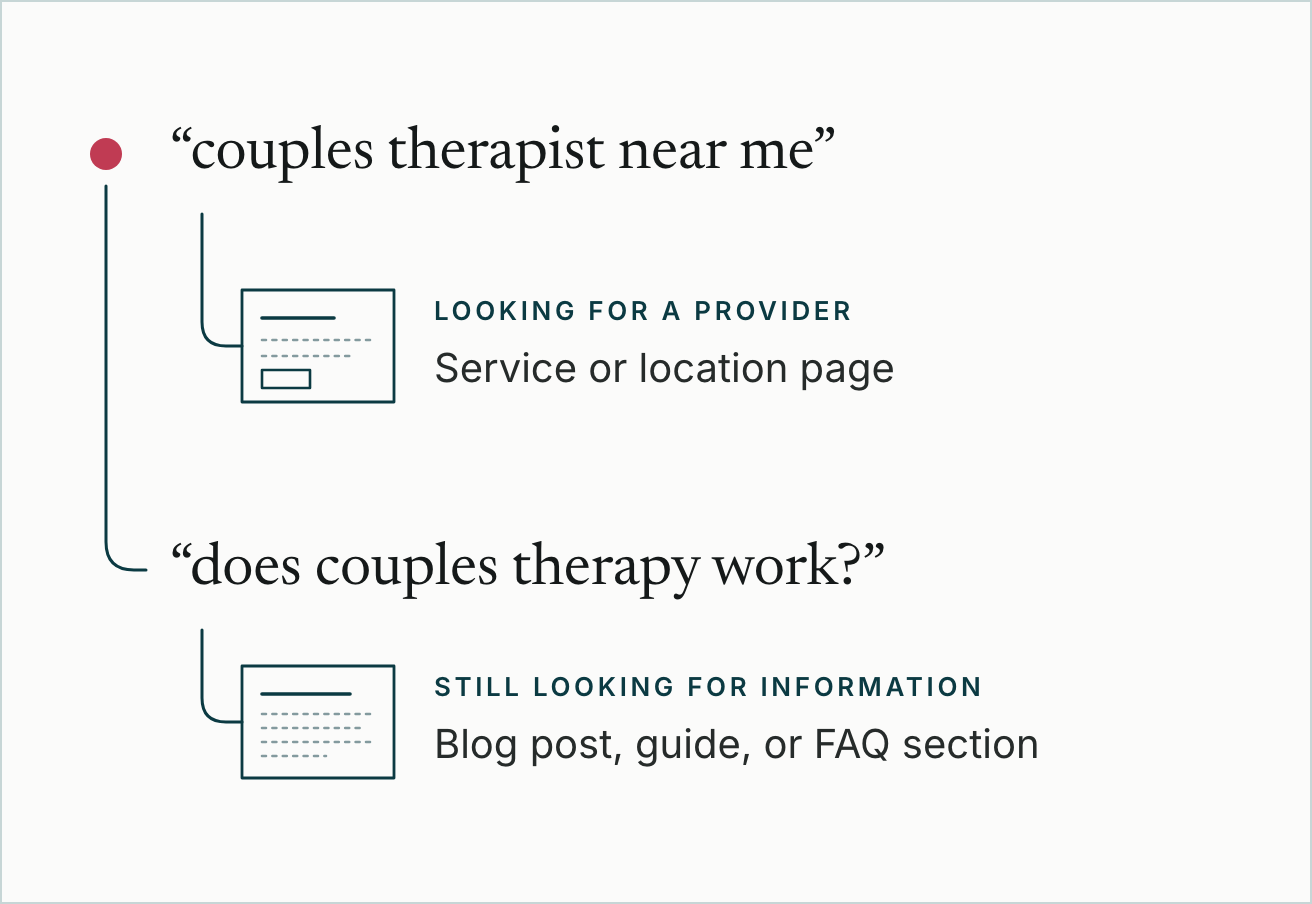
Before settling on a keyword based on search volume, also consider search intent. Someone searching "couples therapist near me" is probably looking for a provider, while someone asking "does couples therapy work?" is still looking for information. The first usually belongs on a service or location page. The second is better suited to a blog post, guide, or FAQ section.
Is SEO Replaced by AI?
AI has changed SEO, not replaced it. According to Google's guidance for AI search, the same basics that support SEO for private practices also help content appear in AI-powered search experiences, including:
- Clear information about your services and business
- Words people actually use when searching
- Useful, original content
- Pages that search engines can crawl and index
- A good experience on mobile
What Helps a Therapy Practice Get Found Online
People searching for therapy don't all take the same route. Some look in Google, some open Maps, some browse directories, and others now ask AI tools for recommendations. To give your practice a better chance of appearing across those searches, have these foundations in place:
A Fully Completed Google Business Profile
A complete profile supports Google SEO for therapists by helping Google understand what your practice offers and where it should appear in local searches. It also gives prospective clients useful details before they ever reach your website. Make sure yours includes:
- The correct business category to clarify what you offer.
- An accurate address or service area to establish geographic relevance.
- Current hours to keep search information accurate.
- Your website and phone number to help people take the next step.
- Useful photos that show your office, team, or location.
While Google encourages businesses to add reviews to their profiles, therapists should be more careful. Major professional codes, including APA Ethics Code Standard 5.05, ACA Code of Ethics Standard C.3.b, and AAMFT Standard 9.2, restrict soliciting testimonials from clients. Clients may feel pressured to say something positive when their therapist asks.
A client may still choose to leave a review without being asked. If you respond, protect their confidentiality by never confirming that they are or were your client. Keep any response general, for example, "We appreciate your feedback and your thoughtful review."
Dedicated Pages for the Services People Search For
Someone rarely searches just "therapy." They search for the particular help they need, such as "anxiety therapist near me" or "couples therapy in Sacramento."
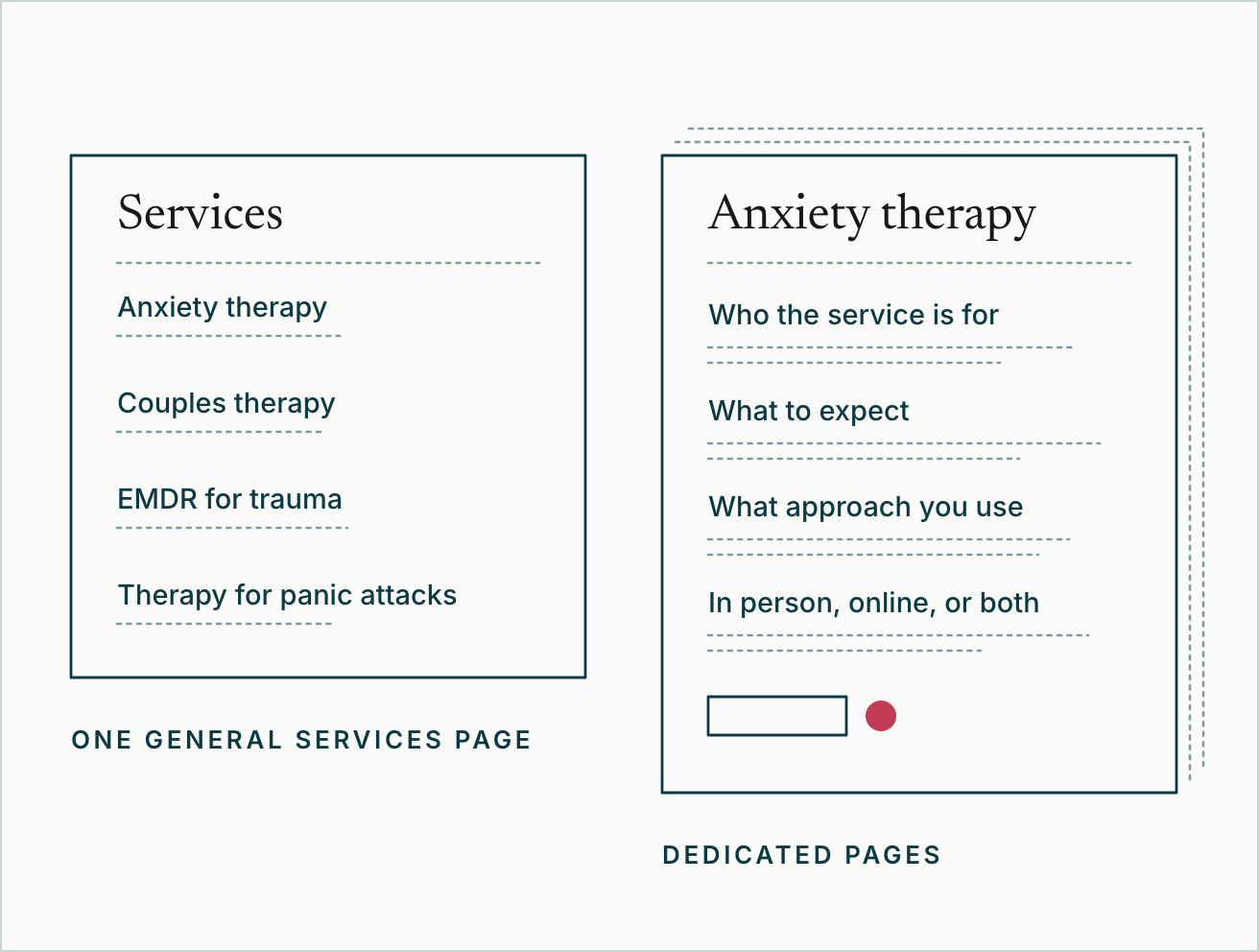
If you bundle all your specialties onto one general Services page, each one may only get a few paragraphs of explanation. That presents two problems.
First, a competitor with a dedicated page will likely have a better chance of ranking because search engines have more relevant information to match with that specific search. Second, scant information makes it harder for potential clients to decide whether you're a good fit.
Giving each distinct service its own page is a simple way of improving your therapy practice's visibility in Google. It also gives you enough room to answer the questions a potential client may have, including:
- Who the service is for and what it helps with.
- What to expect from the therapy process.
- What approach you use.
- Whether you offer the service in person, online, or both.
Clear Information About Where You Practice
Google considers how far a practice is from the person searching when deciding which businesses to show in local Search and Maps. Your website should, therefore, make the real locations and availability of your practice easy to understand. Here's how to do that:
- Mention your city and state on your Contact page, homepage, and relevant service pages.
- State whether sessions are in person, online, or both.
- Keep your website location details consistent with your Google Business Profile.
If you offer therapy services statewide by telehealth, you don't need to create a page for every city you serve. Instead, create one strong state-level page that explains who you serve, what you offer, and how online therapy works. For example, one substantial page like "Online Therapy in Texas" works well.
Content That Answers Real Prospective-Client Questions
Prospective clients often search for answers about what they are experiencing, how therapy works, or whether a certain type of therapy could help before they are ready to contact a therapist. Good search engine optimization for therapists involves answering those earlier questions so your practice has more chances to appear during that research stage.
To find the questions clients ask, look in places such as:
- Google's People Also Ask section
- Google autocomplete suggestions
- Reddit discussions
- Your competitor's content
- Your own Google Search Console queries
- Keyword research tools
- Questions people ask during discovery calls
You don't need to create content around every therapy question with search volume. Prioritize questions that connect closely to the services you offer and could realistically move them toward contacting a therapist.
When writing the content, use the same plain words people type into Google instead of replacing them with vague or more clinical wording. For example, if people search "does couples therapy work?", a clear title could be "Does Couples Therapy Work? What to Expect" rather than something vague like "Finding Your Way Back to Each Other."
Clear Information About Who Is Behind the Practice
Search engines look for signs that content comes from people with real experience, expertise, authority, and trustworthiness so they can surface reliable information to searchers. Those signals matter even more when the topic could affect someone's health or well-being.
A simple way to strengthen those trust signals is to make it obvious who is behind the content and what qualifies them to speak on the topic. Here's how:
- Create a profile page with your name, credentials, license, specialties, and experience.
- Add your name as the byline on articles you write or review, and link it to your profile page.
- Name the therapist on relevant service pages when they actually provide that service.
A Website Search Engines Can Easily Crawl and Index
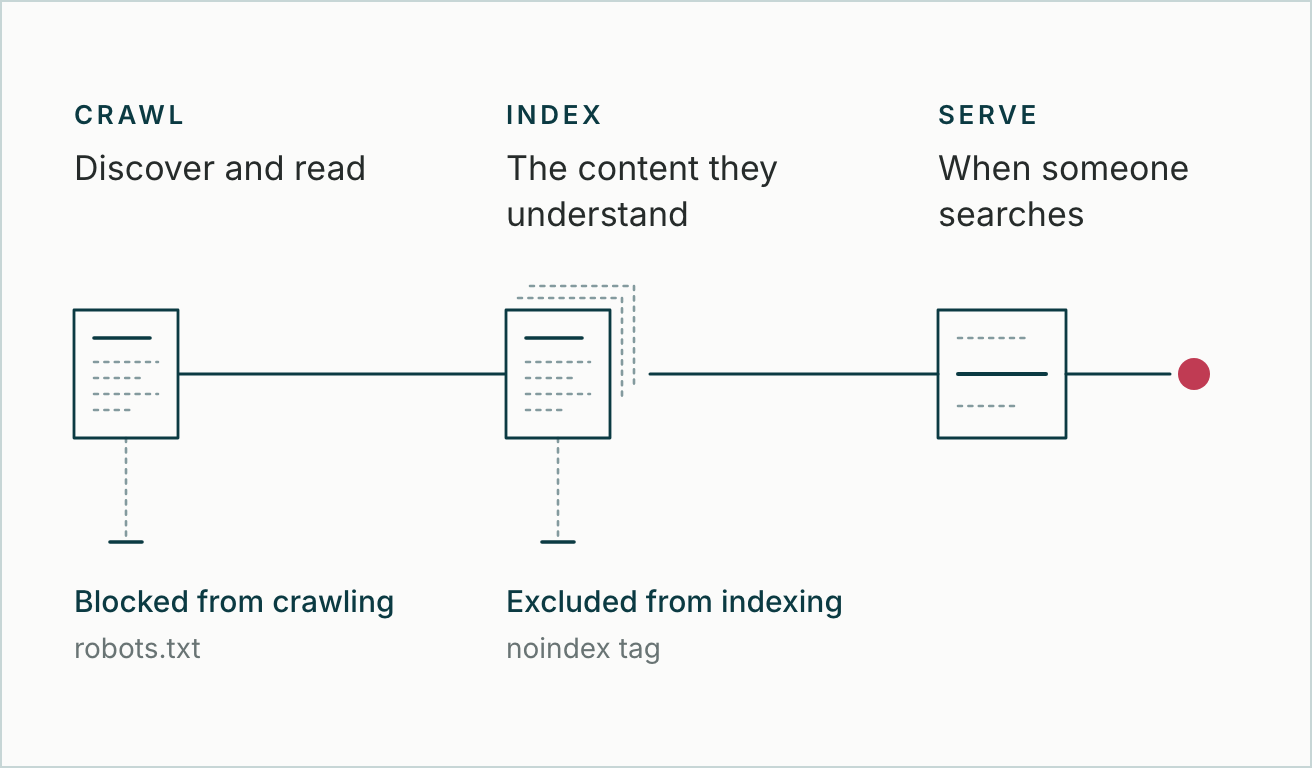
Search engines crawl pages to discover and read them, index the content they understand, and then serve relevant indexed pages when someone searches. If a page on your therapy website is blocked from crawling or excluded from indexing, it can't appear in search results.
Here's how to strengthen your technical SEO so the pages you want people to find are eligible to appear in search:
- Remove accidental noindex tags from any page you want people to find in search.
- Check that robots.txt isn't blocking pages.
- Fix broken links that stop users or crawlers from reaching pages.
- Add internal links between related pages.
- Submit an XML sitemap so Google can discover your main pages.
- Make sure pages load properly on mobile.
- Use clear page titles and headings.
Frequently Asked Questions
What Are the Four Main Types of SEO?
SEO usually falls into four main categories, namely on-page, off-page, technical, and local SEO. On-page SEO is about making each page on your website the best possible match for a specific search. That means covering the topic well, using clear titles and headings, and making it obvious to both Google and the reader what the page is about.
Off-page SEO builds trust in your website through signals from elsewhere online, such as backlinks, mentions, and reputable directory listings. Technical SEO makes sure search engines can access, crawl, and index your pages without running into problems. Local SEO helps your practice appear when people search for therapists in a specific area, especially in Google Search and Maps.
How Long Does SEO Take to Work?
SEO usually takes around 3 to 6 months to produce meaningful results. However, you may see early signs of progress sooner, such as a page getting indexed, impressions increasing, and new search terms appearing in Google Search Console.
SEO tends to show results faster when:
- Your website is already established and has some search history.
- Your target searches are less competitive.
- Your existing pages are already strong and only need focused improvements.
- Search engines already crawl your site regularly.
- You make several meaningful SEO improvements at once.
How Can You Tell if Your SEO Is Working?
A strong early sign that your SEO efforts are paying off is that your pages start appearing for more relevant searches and gaining impressions in Google Search Console. Other signs of progress include:
- Higher rankings for the searches relevant to your services.
- More organic clicks to service and location pages.
- More qualified inquiries coming from search.
- More visibility in local results such as Google Maps.
Track your search visibility alongside clicks and qualified inquiries so you can tell whether your SEO is bringing business value, not just better numbers.
How Can You Improve SEO Quickly?
If you want faster SEO progress, improve pages that are already getting impressions. Strengthen weak areas, such as content, page titles, internal links, or how well the page matches the search. You can also speed up results by:
- Adding internal links between related pages across your website.
- Refreshing outdated pages that have lost visibility.
- Fixing indexing issues on pages you want found.
- Completing and correcting your Google Business Profile.
- Combining pages that target very similar searches.
What Are the Latest SEO Techniques?
Recent changes in search have added a new layer to SEO rather than replacing the fundamentals. Much of that new layer focuses on helping AI systems understand, surface, and accurately describe your practice. The newer SEO practices include:
- Optimizing for query fan-out by covering related subtopics and questions.
- Creating content with real information gain.
- Tracking appearances in AI answers alongside traditional search performance.
These techniques work best when they build on solid SEO basics such as clear site structure, crawlability, and accurate business information.
Using SEO for Therapists to Improve Visibility
Effective SEO for therapists starts with getting the basics right, from your service pages and location details to your website content and technical setup. Together, these help search engines understand what you offer, where you practice, and when your pages are relevant to people searching.
At Credible by Design, our 5-star Google rating reflects our expertise in strategy, copy, design, and development. We've also written 1,000+ SEO and AI-optimized articles, giving us hands-on experience creating content designed to get found in search. Get a free website audit to find the gaps limiting your search visibility.


