



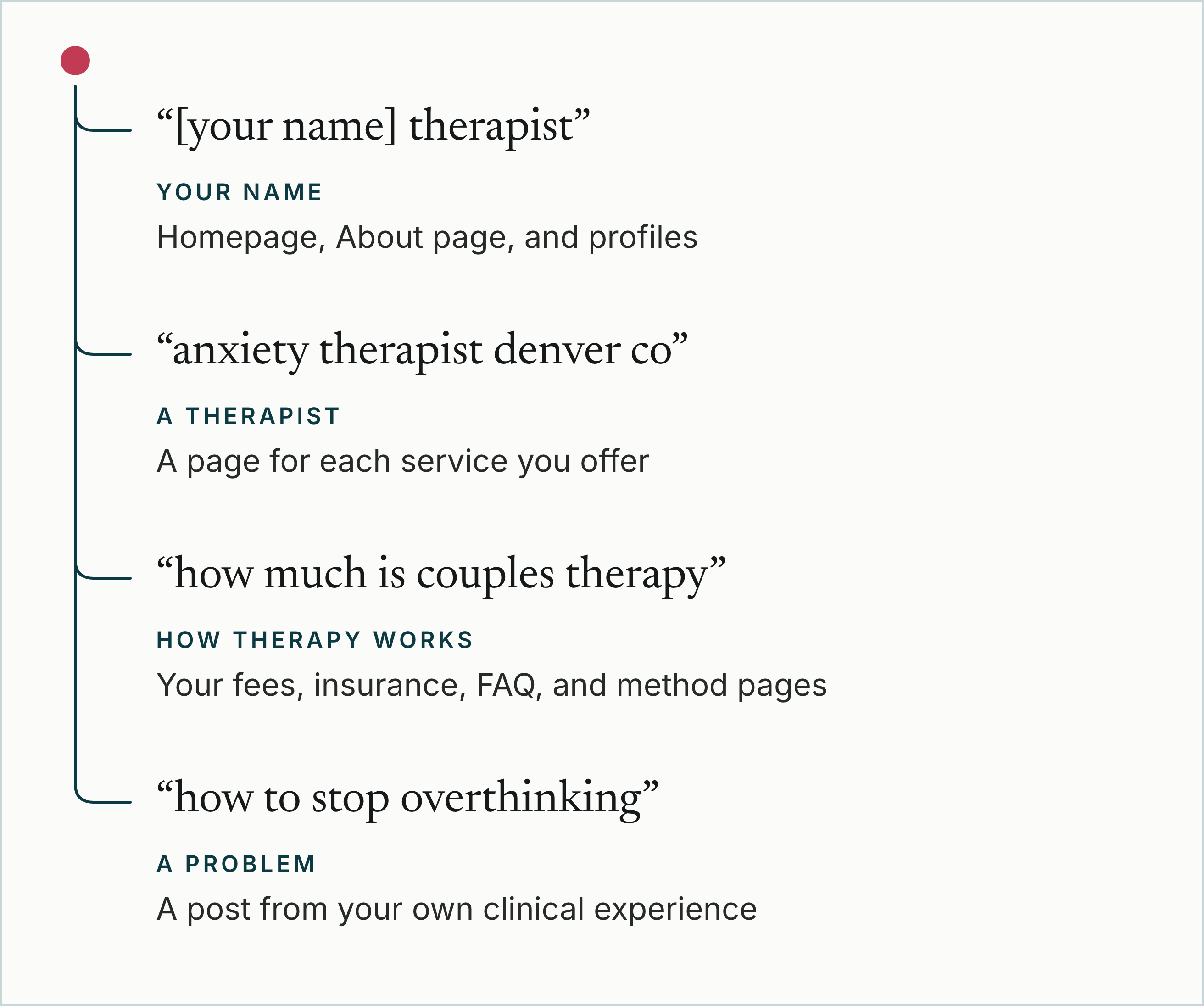
People reach a therapy practice through four kinds of search. They search for your name, search for a therapist, ask how therapy works or what it costs, or ask about a problem. Each kind is answered by a different page, and Google treats each one differently.
We looked at 331 Google searches across two tests. This guide shows what Google put first for each kind of search, and which page on your site should answer it.
What Are the Four Kinds of Search?
People who study search have sorted searches by what the person wants since at least 2002. That year, Andrei Broder described three kinds: searches to reach a site, to learn something, and to do something (ACM SIGIR Forum, 2002). For a therapy practice, that becomes four kinds.
| Kind of search | What the person wants | Example searches | The page that answers it |
|---|---|---|---|
| Your name | To reach you, or to check you after a referral | "[your name] therapist", "[practice name] reviews" | Your homepage, About page, Google Business Profile, and directory profiles |
| A therapist | Someone who can help, nearby or online | "anxiety therapist denver co", "online therapist texas" | A page for each service you offer, plus your Business Profile |
| How therapy works | To decide whether to start, with whom, and at what cost | "how much is couples therapy", "emdr vs cbt", "sliding scale therapy" | Your fees, insurance, FAQ, and method pages |
| A problem | To understand what is happening to them | "how to stop overthinking", "signs of trauma" | A post written from your own clinical experience |
One person often moves through several kinds. Someone may read about panic attacks one month, look up what therapy costs the next, and then search for an anxiety therapist in their city.
How We Looked
- Searches for a therapist. On October 8, 2026, we ran six searches in the largest city of each state: 300 Google searches in all. The full study is in Where Google and ChatGPT Send People Looking for a Therapist.
- Questions about therapy and about a problem. On November 5, 2026, we added 31 searches. Each has at least 100 searches a month in the United States, according to Google Ads. We recorded Google's first page and its AI Overview, set to the United States as a whole, on desktop.
- Who published each result. We sorted every first-page result by who published it: practice sites, hospitals and universities, nonprofits, directories, online therapy companies, media, social sites, and others. Practice sites include solo and group practices and community counseling agencies.
We name no practice in this guide.
Who Searches for Your Name?
Name searches come from people who already know of you. A colleague or physician referred them, a friend mentioned you, or they saw your directory profile. Most of them have nearly decided. They are checking.
They want to confirm that you are real, current, and reachable. They look for your photo and credentials, your fee, whether you are taking new clients, and one phone number that works.
What they find may come from elsewhere. An old group practice page, a stale directory listing, or a site that republishes license records can sit above your own. Each may show a different phone number or an old address.
The page that answers it: your homepage and About page, your Google Business Profile, and each directory profile. They should all give the same name, phone number, fee, and availability.
Check it yourself: once a quarter, search your own name and your practice's name on your phone, in a private window. Note what comes first and whether its details match your site.
What Does Google Show When Someone Searches for a Therapist?
In our October study, Google showed a map pack on 273 of 300 searches. On "therapist near me", Psychology Today was the first result in 31 of 50 cities. Practice sites held 21% of the first-page positions on that search.
When the search named a need, practice sites held about half of the first page:
| Search, in each of 50 cities | Practice sites' share of first-page positions |
|---|---|
| therapist near me | 21% |
| anxiety therapist [city] | 52% |
| trauma therapy [city] | 52% |
| child therapist [city] | 51% |
| online therapist [state] | 41% |
| couples counseling [city] | 40% |
The more specific the search, the more room there is for a practice's own site. A page for each need you treat, named in the words people search with, gives Google a page that matches. Add your city, your state, or online care where it applies.
Google says local results depend on relevance, distance, and prominence. It also says no one can pay for a better local ranking (Google Business Profile Help). Relevance is the part you write. Your Business Profile's categories and services, your Psychology Today profile, and your service pages should name the same needs.
The page that answers it: a service page for each specialty you want to be found for, such as anxiety, trauma, or couples work.
Which Questions About Therapy Can a Practice Win?
These are the questions people ask while deciding: what it costs, whether insurance helps, which method fits, and how long it takes. We tested 18 of them.
- Google showed an AI Overview on all 18.
- A practice site was on the first page for 16 of the 18.
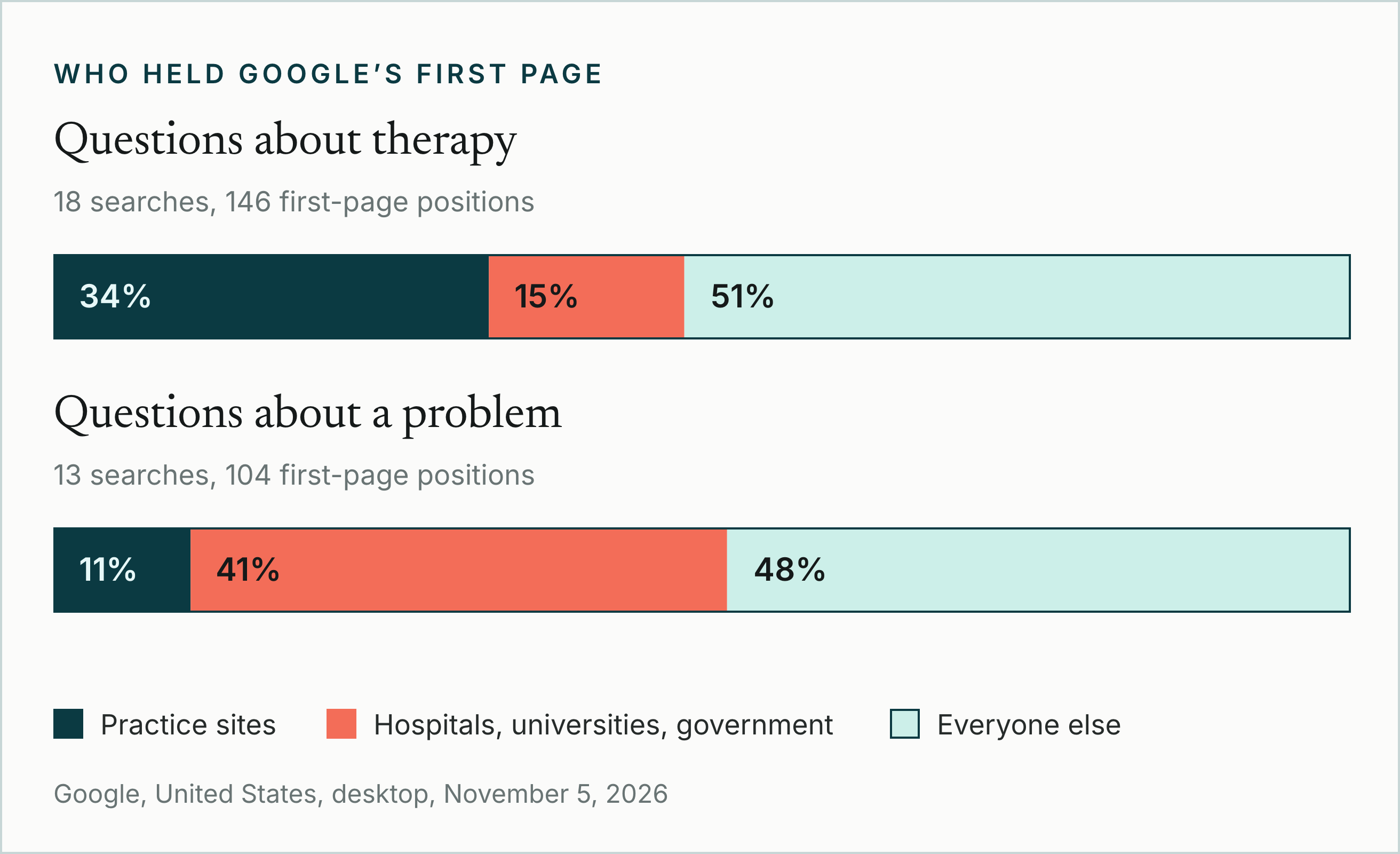
- Practice sites held 49 of 146 first-page positions (34%), more than any other kind of site. Hospitals and universities held 22 (15%).
- Practice sites made up 28 of the 144 sources the AI Overviews cited (19%).
The practice pages that won answered a practical question about one service. On "how much is couples therapy", all 8 first-page results were practice sites, each a cost or fees page. Three of them named a city or state. On "how much does therapy cost", 3 of the 8 results were practice pages, and two covered costs in one state. On "sliding scale therapy", practices held 5 of 9, three of them for a named city. On "emdr vs cbt", they held 5 of 8.
Definitions went elsewhere. "what is emdr therapy" draws 33,100 searches a month, and "what is cbt therapy" 9,900. Neither showed a practice site on the first page. Health systems, government sites, and professional associations held them.
So the questions a practice can win are the practical ones about cost, coverage, and method. They also sit closest to a decision. Many practice sites still leave them unanswered. In our October study, fewer than half of the practice sites people reached stated a session fee (1,518 of 3,393).
The page that answers it:
- A fees page that states your fee, how payment works, and whether you take insurance. Explain superbills or a sliding scale if you offer them, and name your state where coverage rules differ.
- An FAQ that answers the questions clients ask before the first session.
- A page for each method you use, saying how you use it and who it suits.
For the features that help a visitor act on those answers, see therapy website features that convert visitors.
Should You Write About the Problems You Treat?
We tested 13 searches about a problem, such as "how to stop panic attacks", "signs of trauma", and "how to deal with grief".
- Google showed an AI Overview on all 13.
- Hospitals, universities, and government sites held 43 of 104 first-page positions (41%). One of these came first on 9 of the 13 searches.
- Practice sites held 11 positions (11%), spread across 5 of the 13 searches.
- Of the 147 sources the AI Overviews cited, 5 were practice sites. 54 were social sites, mostly YouTube videos.
AI assistants behave the same way. In our test of ChatGPT, Gemini, and Meta AI, every answer to a question about overthinking gave general self-help and named no practice.
Problem searches matter to the person and rarely lead straight to an inquiry. A practice post competes with Mayo Clinic, Cleveland Clinic, and the National Institute of Mental Health. Ten of the 11 practice posts on the first page were about overthinking, trauma, or relationships.
Write about a problem when you have something first-hand to add. Google's own guidance asks whether content shows first-hand expertise and offers original information (Google Search Central). Then link the post to the matching service page and your fees page, so a ready reader knows the next step.
Any page about a problem should also say where to go in a crisis. The 988 Suicide & Crisis Lifeline takes calls, texts, and chats at 988.
The page that answers it: a post written from your own practice, linked to the service it relates to.
Which Page Should Answer Each Search?
| Kind of search | What Google showed in our tests | The page that answers it | How to check it |
|---|---|---|---|
| Your name | Not measured here; check your own | Homepage, About page, Business Profile, directory profiles | Search your names each quarter and compare the details |
| A therapist | Map pack on 273 of 300; practice sites held about half the first page when a need was named | A service page for each specialty | Search "[need] therapist [city]" and find your page |
| How therapy works | AI Overview on 18 of 18; practice sites held 34% of the first page | Fees, insurance, FAQ, and method pages | Search your cost and insurance questions with your city or state |
| A problem | AI Overview on 13 of 13; a hospital, university, or agency first on 9 of 13 | A post from your own experience, linked to a service | Ask new clients what they read before they contacted you |
How Can You See Which Searches Reach Your Site?
Google Search Console shows the searches your site appeared for. In the Performance report, the Queries tab groups your data by what people typed. It shows the last three months unless you change the date range (Search Console Help).
Sort each search into one of the four kinds:
- Name searches show who already knows you.
- Searches for a therapist show whether your service pages match the needs people name.
- Questions about therapy show which fees, FAQ, or method pages Google offers.
- Questions about a problem show which posts reach people early.
Impressions show where Google displayed your site. Clicks show where people chose it. A search with many impressions and no clicks often means your page sits too low, or its title answers a different question.
Then ask every new client the same question: how did you find us? Their answers cover what Search Console cannot, such as referrals and AI assistants.
What We Don't Know
- One day, one setting. The 31 new searches ran once, on November 5, 2026, for the United States as a whole, on desktop. Phone results and city results differ, and results move from week to week.
- Our wording. We wrote the 31 searches. Google Ads shows that people make each one, but they are a sample of what people ask.
- Position is not choice. A first-page position tells you nothing about clicks or inquiries, or why the page ranks.
- Sorting is judgment. We sorted every site by hand. For 9 sites we could not confirm the type. They hold 7 of 250 first-page positions, and none of the 7 is counted as a practice site.
- Name searches. We did not test them for this guide.
See How Your Practice Shows Up
Each kind of search needs its own page, and most practices are missing at least one. Our free credibility audit reads your site and your profiles the way a stranger would. It is a written audit naming the fixes we would make first, with the evidence behind each one. It arrives within 3 business days, as a link.
If the gap is the pages themselves, our Content & Copy Project writes them: fees, FAQ, service, and method pages, priced by what needs writing. We work with therapy and private healthcare practices.


