



Long before Whitney Goodman wrote a book about toxic positivity, someone found her therapy practice online. She thinks her first client found her through Psychology Today. Her website began bringing people in, too. The Instagram audience many people know her for came later, she said in her interview on Heard Business School.
For years, Justin K. Dodson's friends had asked whether he could see someone they knew. He kept having to say no. When he opened his practice in 2020, those friends referred his first few clients, he told Heard Business School.
His opening day came after years of people asking for his help. When comparing your start with another therapist's, ask what relationships existed before they opened.
If you're opening a US therapy practice, start with the appointment you can offer. Who already gets asked for help finding that appointment? If a former colleague has asked whether you see teens after school, start there. If you've moved somewhere new, try the directory a family would get from its health plan or school. Follow one of those routes far enough to see whether someone could actually book with you.
The rest of this guide compares the common sources of first clients and when each can start. That includes how long insurance credentialing takes, and what to do if you're leaving a group practice or agency. Along the way, you'll write an answer you can carry into your business plan.
What the Referral Numbers Can Tell You
In Heard's 2025 survey, 38% of respondents named referrals or word of mouth as their most common source of new clients. Another 35% named Psychology Today. Each therapist named one top source, whether it accounted for a handful of clients or nearly everyone they saw.
Heard's 2026 report asked which sources practitioners used. In that survey, 83% reported referrals or word of mouth, and 82% reported online directories. A practice could use both. Neither set of figures tells us where a newly opened practice got its first client.
People seeking care give you another place to start. Delboy and Michaels surveyed US adults in 2023. Among current or recent therapy patients, 40% recalled looking for a covered therapist on their insurer's website. Asking a doctor for referrals was also common, at 32%. Someone could ask a doctor for a name and still check whether that therapist took their insurance.
For your own opening week, talk to a colleague who recently tried to help someone find care. Ask which appointments were hardest to find. You may already have one of those hours free.
Is It Harder to Get Therapy Clients in 2026?
Demand has grown since 2019, and so has the number of clinicians with room. The people you hope to see have more choices.
- More people are in therapy. In 2019, 9.5% of US adults got counseling or therapy from a mental health professional. By 2024, 14.0% did, the CDC's National Center for Health Statistics reports.
- More clinicians have openings. Psychologists with no openings for new patients fell from 65% in 2021 to 46% in 2025, in the American Psychological Association's practitioner survey. Its sampling changed in 2023, so the early years compare loosely.
- New practices have the most room. In SimplePractice's 2025 report, 92.1% of clinicians in their first year on the platform were open to new clients. After two years, 77.8% were.
- Clients are leaning toward insurance. On SimplePractice, 58.8% of 2025 sessions were billed to insurance, up from 55.8% in 2024. Teladoc, which owns BetterHelp, reported a "faster than expected shift in demand" toward insurance-covered services in its October 2026 filing.
- Telehealth widened the field. A telehealth practice can reach clients across its state, and so can every clinician licensed there. The Counseling Compact began granting privileges to practice in September 2025, and it's live in 11 states.
In Heard's full 2026 report, 44.3% of practitioners named getting clients among the hardest parts of starting. When more clinicians have room, the person referring has more names to choose from. A specific opening gives them a reason to choose yours.
Start With the Opening You Actually Have
"I see adults with anxiety" leaves a colleague with work to do. Picture a private-pay opening at noon on Tuesdays. Someone who wants to use insurance and can only come after work needs a different name. Your colleague could trust your work completely and still have good reason to pass along somebody else's details.
Write a note a colleague could forward unchanged. Include whom you see, where the visit happens, when you have room, how payment works, and how to reach you. Here's what that might sound like for a therapist working with adults after a loss.
I have a Tuesday lunchtime opening for an adult seeking grief counseling in person in Madison. I'm private pay. My session fee and consultation number are on this page.
Now read it as someone who has an hour for lunch. Is the office close enough? Can you see the fee before making the call? Someone who needs an evening appointment can keep looking without having to explain their schedule to a stranger.
Patients weigh the hour, too. In the patient survey by Delboy and Michaels, 52% of recent therapy patients counted network status among the most relevant factors in choosing a therapist. A convenient location (41%) and a convenient schedule (35%) came next.
How Many New Clients Do Your Openings Actually Require?
Suppose you're opening six weekly appointment times. Two people have already arranged to continue seeing you weekly. You have room for four new people who want weekly visits. Someone interested in a single consultation can use an hour this week. That hour will be open again next week.
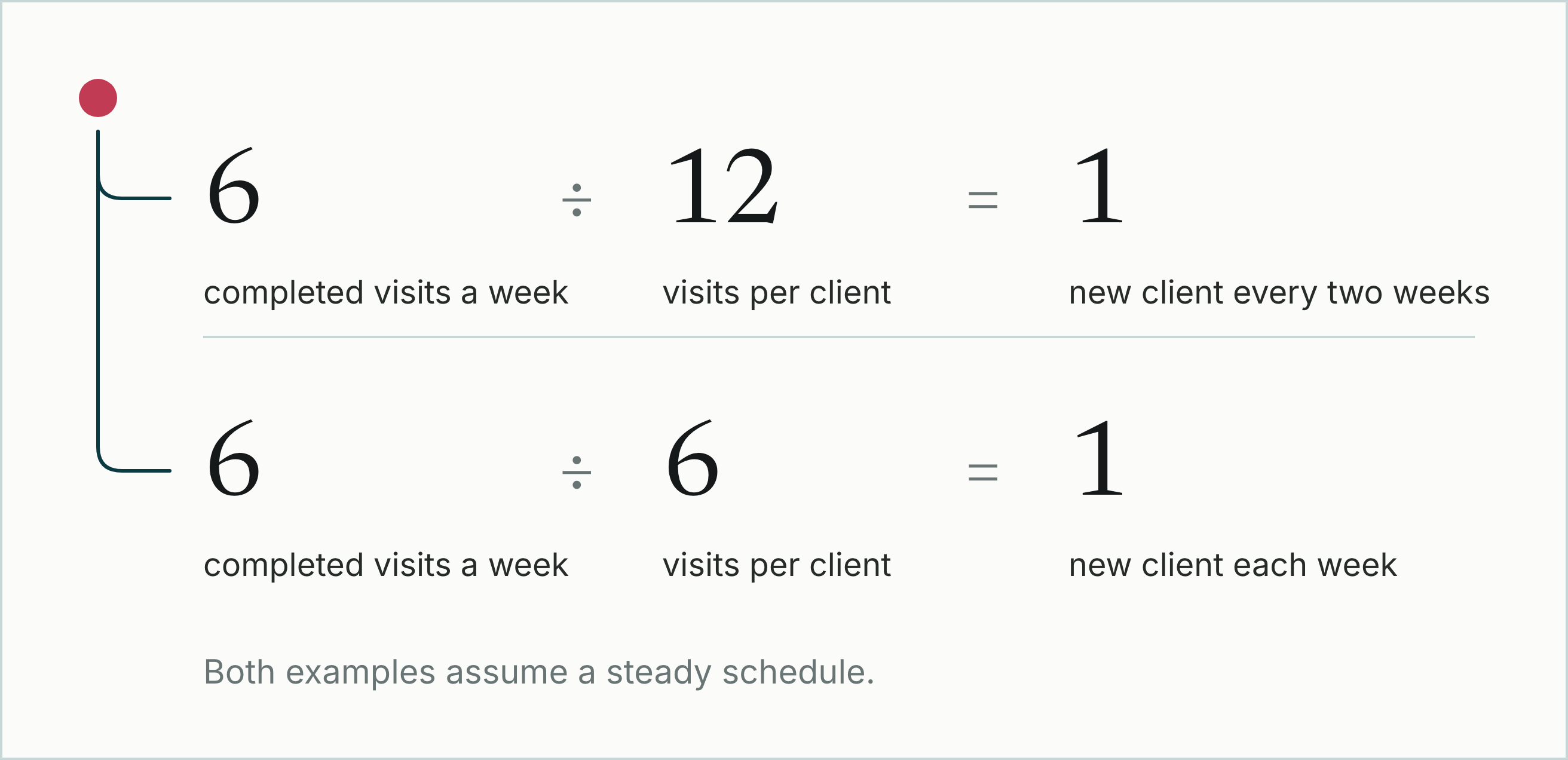
Once those six weekly hours are spoken for, the arithmetic changes. Suppose you average six completed visits a week, and each new client attends twelve visits in total. Over time, you'd need one new client every two weeks to sustain that pace. If clients average six visits instead, you'd need one new client each week. Both examples assume a steady schedule. Use your own average once you have enough completed courses of care to work it out.
Keep the appointments already arranged separate from the new people who find you. One count tells you how much room you have. The other tells you whether your referral sources are working.
How Many Clients a Private Practice Therapist Usually Sees
Full means different things in different practices. Heard's 2026 survey put the median solo caseload at 18 clients a week. Most solo owners in SimplePractice's 2025 survey scheduled 15 to 24 sessions a week. Its platform data, which includes part-time practices, put the median solo clinician near 11 sessions a week.
Until you have your own averages, two national figures can stand in. US adults in therapy averaged 9.8 therapy visits a year in 2018 and 11.8 in 2021, Olfson and colleagues found. In Swift and Greenberg's review of 669 studies, about one client in five dropped out of therapy early. In private outpatient settings, 17.4% did.
Therapists often describe longer stays. In Heard's 2025 survey, 39% said they typically work with a client for more than a year. Both pictures hold at once. Long stays fill the calendar you see. Short stays, including people who come once, decide how many new clients you need.
For scale, psychologists in the APA's 2024 survey reported a median of six new people contacting them each month. Some of those contacts never become first visits.
Choose a First Source That Fits the Practice You're Opening
If Colleagues Already Know Your Work
Think of the last time another clinician asked, "Do you know anyone who sees …?" What came after those words? A former colleague may know your clinical work well and have no idea you now offer evening appointments. Another may know you have openings but usually hears from people seeking a different kind of care.

Start with the person whose last question you could answer today. Ask what they did when it last came up. They may have given out a few names, sent a directory link, or handed the search to someone else in their office.
If a colleague mentions a waitlist, ask what those families are waiting for. If everyone needs an after-school visit, a Tuesday at noon won't help much. You can be the right therapist and have the wrong hour free.
Ask about demand for the hours you can reliably offer before changing your schedule. A daytime opening needs a referral source whose clients can attend then.
If You're Building a Caseload Inside a Group Practice
You may be joining an established practice while finding your own first clients. Ask the owner or intake coordinator how a new inquiry reaches a particular clinician. Does the caller choose from profiles, or does someone suggest a name?
Confirm who keeps your profile current and what the practice expects you to do to attract inquiries. Give the person handling intake your current hours, payment details, and the people you can help. Ask how many suitable inquiries reached you, as well as how many reached the practice.
If a Doctor's Office Already Sees the People You Hope to Help
A 2025 American Academy of Pediatrics survey asked 801 primary care pediatricians what got in the way of treating and referring mental health conditions. Long waits to see a mental health provider topped the list, at 77%.
Waiting costs referrals, too. In a study of 2,690 primary care patients referred for behavioral health, 82% of same-day first visits were kept. Of visits more than 30 days out, 29% were kept, Pace and colleagues found.
If you see teenagers, ask a local pediatric office who helps families find a therapist. Ask what makes those searches difficult. If the office needs someone who accepts a particular plan and sees teenagers after school, give them those details when you have that opening. Include the number a parent can call. Let the office know when the appointment is taken.
If You're in Network and New to the Area
You may have few local contacts and still have somewhere to start. Once your participation in a particular plan is active, try finding yourself from the member's side. Choose the exact plan, ZIP code, type of appointment, and any filters a prospective client would reasonably use. Follow the displayed contact details. An old group number can keep delivering your calls to a perfectly helpful receptionist at the wrong practice.
Researchers writing in JAMA Health Forum made 5,822 calls to psychiatrists and psychologists listed by the largest commercial insurer in five states. Of the 2,252 calls with a definitive outcome, 55.6% encountered a directory error. Contact information was the most common error. The study gives a new practice a reason to check its own listing before spending money to get another one.
Members lean on those listings. In a 2018 survey, 44% of privately insured adults who used outpatient mental health care had used their insurer's directory. Of those, 53% found an inaccuracy, Busch and Kyanko reported. Federal law requires providers to send plans their directory information when a network agreement begins or ends, and when it changes materially. Tell each plan when your address or phone number changes.
If your application is still pending, ask the plan when you can start seeing its members in network. Typical credentialing times are covered below.
If You're Private Pay or Starting Without a Local Network
A specialist directory may make sense if people look there for your training. A campus counseling center may make sense if its students can use your appointments and afford your fee.
One therapist writing on Reddit recalled getting their earliest referrals from a group practice. A university counseling center became a source later. If you have a college in mind, find out who picks the names students receive.
At the University of Oregon, students can browse community therapists on Thriving Campus or work with a case manager. They can filter by insurance and specialty, see availability, and contact providers. The university invites local therapists to add their own profiles.
At Wake Forest, the counseling center maintains a database it uses to help students find care. It directs clinicians interested in inclusion to its clinical case manager. "I'm hoping for university referrals" sounds like the same plan in both towns. In one, you can start by filling out a profile. In the other, you have a specific person to ask how the list works.
The International OCD Foundation offers a different example. Its directory lets people distinguish nearby providers from teletherapy providers and search for experience with particular concerns, including perinatal OCD. Someone whose training fits that search can check the listing criteria and the choices a visitor sees. A general promise to help with life's challenges would give that visitor little to go on.
Find the resource a local doctor's office, campus, or relevant community organization actually gives people. Look for your kind of appointment using its own terms. If it lists only clinicians who take the student health plan and you're private pay, you have your answer. Save that introduction for a setting where the appointment you offer is one people can use.
If You're Counting on Google, Social Media, or Ads
Ask what someone would have to know before seeing you there. Searching your full name usually means the person already has it. Searching for a therapist who sees couples on weekends is a different opportunity. One search helps someone check a recommendation. The other can introduce a stranger to your practice. Our post on how people search for a therapist covers both kinds.
Search usually starts slowest for a new website. Google's own guide says some changes take effect in a few hours, while others "could take several months." A Google Business Profile is free. A practice that hasn't opened yet can add an opening date up to a year ahead. Once you verify the profile, it shows on Google 90 days before that date.
A directory can take part in either search. In our October 8, 2026 study across 50 US cities, Psychology Today appeared in the top ten organic results for 267 of 300 Google searches. We recorded what appeared on screen. To learn whether a particular listing led to a first appointment, you'd have to hear from the practice or the person who booked.
Psychology Today costs $29.95 a month with no contract. Whether its inquiries are falling is disputed. In a 2025 survey of 152 clinicians, mostly in Utah, 53% of answers about directory referral flow described a decrease. Psychology Today told ClearHealthCosts in December 2025 that directory visits hadn't declined overall and total contacts hadn't materially changed. Our Psychology Today profile examples show what a full profile includes.
If you teach workshops for new parents, ask the organizer where participants look for resources afterward. If they follow the organizer's social account, that gives you a specific place to share your practice details.
Few practices rely on ads most. In Heard's 2025 survey, 3% named Google or Meta ads as their top source of new clients.
Before paying for an ad, write down what you would need to learn from it. Suppose you advertise evening appointments and get inquiries only for a plan you don't take. That tells you to examine the ad and the fee information together. Buying more clicks would repeat the same experiment. Set a limit you can afford and decide in advance what would justify another round.
Leaving a Group Practice or Agency to Open Your Own Practice
If you've worked in a group practice, agency, clinic, or hospital, you open with a head start. Colleagues know your work, referral sources know your name, and some clients may want to keep seeing you. Each of those needs care during the move.
Read Your Agreement First
Before you tell anyone your plans, read your employment or contractor agreement. Look for a non-compete, a nonsolicitation clause covering clients or staff, and terms about notice and client records.
There's no federal ban on non-compete agreements. A federal court set aside the FTC's rule in August 2024, and the FTC removed it in February 2026. Several states restrict them. Minnesota bans non-competes for nearly all workers, and Washington will from June 30, 2027. Maryland and Maine limit them for many health care workers. Minnesota's ban doesn't cover nonsolicitation or client-list clauses.
Clients Who May Want to Continue With You
Each profession's code has a standard on this, and they differ. Here is each one, with its number, so you can read it in your own code.
- Counselors. The ACA code lets counselors refer an organization's clients to their own practice only where its policies explicitly allow it. Those clients must hear their other options (A.10.a). Counselors also don't use a workplace to recruit clients for a private practice (C.3.d).
- Social workers. The NASW code asks social workers leaving a job to tell clients their options for continuing services, with each option's benefits and risks (1.17(f)). It also says not to solicit a private fee from clients entitled to those services through the employer (1.13(c)).
- Psychologists. When psychologists take a job, the APA code asks them to plan an orderly handover of client care if it ends (10.09). The client's welfare comes first.
- Marriage and family therapists. The AAMFT code asks therapists to make reasonable efforts to arrange continuing care before ending treatment (1.10).
- Speech-language pathologists. ASHA's ethics guidance says that once clients are fully informed of their choices, they have the right to choose their provider.
Ask your employer how departures usually work: who tells clients, which options they hear, and how records move. If a client chooses to continue with you, count them apart from new inquiries, as the caseload section describes.
Tell Your Referral Sources Where You've Gone
The colleagues, doctors, and school counselors who sent people to you may know only the group's phone number. Once your agreement allows it, send them your new details. Write them like the note earlier in this guide: who you see, when, where, how payment works, and how to reach you.
Check every listing that still carries your name. The group's website, its directory profiles, and insurer directories can keep routing calls to your old desk. Ask the group how it will update or remove them.
If you saw insurance clients under the group's contract, ask each plan how your participation moves when you leave. At some plans, credentialing and the contract are separate steps: Aetna says credentialing is a separate process from network contracting. Plan your opening date around the credentialing times in the next section.
Some clinicians keep part-time hours at their group while their own practice starts. If you do, check that your agreement allows a practice alongside it, and keep the two caseloads apart.
How Long Does Insurance Credentialing Take for Therapists?
If you'll take insurance, credentialing is usually the slowest clock in your plan. Plans that publish a figure give 45 to 90 days from a complete application. Anthem Blue Cross in California says it typically takes 45 days. Blue Shield of California gives 45 to 60 days for a completed behavioral health application. Evernorth, Cigna's behavioral network, says it can take up to 90 calendar days.
Approval brings one more date. Blue Shield of California sends a welcome letter with the contract's effective date. Visits with its members before that date are processed as out-of-network. That date tells you when you can offer an in-network appointment. When the first member will call is a separate question.
Some plans first decide whether they need another clinician where you practice. Aetna says it reviews each request to join against its current network in that area. In Texas, Cigna accepted network applications only from February 1 to 28, 2026, Evernorth's page says.
A few states set deadlines once a plan has a complete application: Minnesota 45 days, Arizona and New York 60, and Oregon 90.
Most plans start from the same groundwork. Get your NPI, and complete your CAQH profile so it matches your license and practice details exactly. Then apply first to the plans your future clients use most.
Employee assistance programs often run through the same networks. Evernorth's program covers at least three free counseling visits per issue, and clinicians join it through Evernorth's behavioral network.
Medicare for Counselors and Marriage and Family Therapists
Medicare can move faster. Marriage and family therapists and mental health counselors have been able to bill Medicare directly since January 1, 2024. They need at least two years or 3,000 hours of supervised clinical experience after their master's degree.
CMS says clean online applications are generally processed within 15 calendar days. Under Medicare's rules, billing starts on the later of two days: when you filed the approved application, or when you began seeing clients there.
More than 27,000 of these clinicians billed Medicare in 2024, a 2026 Health Affairs study found. By our count of CMS's public enrollment data, more than 80,000 were enrolled by 2026. Enrollment makes you billable. Medicare patients still find you through the sources above.
You Don't Need a Credentialing Platform
Platforms such as Headway, Alma, Grow Therapy, and Rula offer to credential you faster and send clients your way. They're optional. You can credential with each plan directly, as above, and hold the contract in your own name.
Their speed comes with terms. The insurer contract can sit with the platform: Alma's provider page says members are credentialed under Alma's tax ID. Headway's page says it keeps a small amount of the rates it negotiates. Grow's booking team answers the calls and emails from Psychology Today profiles it runs for you. In October 2026, ClearHealthCosts reported a new Headway fee of $9.99 per appointment with clients found through its marketplace, in five states.
We recommend none of them. Every other route in this guide works without one.
When Each Source Can Start
Each source runs on its own clock. The times below come from the organizations themselves.
| Source | What starts the clock | Published time |
|---|---|---|
| People who know your work | Telling them you have openings | Right away |
| A directory profile | Joining and writing your profile | "Get your profile live today," says Psychology Today |
| A specialty directory | Membership and a listing | 5 to 7 business days at the International OCD Foundation |
| Google Business Profile | Verifying the profile with an opening date | Shows on Google 90 days before your opening date |
| Medicare | A clean online application | Generally 15 calendar days, says CMS |
| A commercial insurer | A complete application | 45 to 90 days at plans that publish a figure |
| An employee assistance program | Joining the parent network | Up to 90 days at Evernorth |
| Clinicians who refer | Repeated contact | No published time |
| Search, for your website | Google finding and ranking your pages | "A few hours" to "several months," says Google |
Read as a sequence, those times suggest an order: start the slowest clock first.
- Four to six months before you open, if you'll take insurance. Complete your CAQH profile, and apply to the plans your future clients use most.
- About three months before. Launch your website, and add your opening date to a Google Business Profile. Enroll in Medicare if your license, experience, and clients fit it.
- About one month before. Publish your directory profiles. Tell colleagues and referrers your opening date and the appointments you'll offer.
- Opening week. Send yourself a test inquiry. Decide who answers and how fast, and start counting where each inquiry came from.
Give the Person Who Receives Your Name Somewhere Useful to Go
Try a small exercise with a colleague. Send them the link you expect a referrer to share, with no explanation. Ask them to tell you what they think you offer, what it might cost, and what they would do next. Then ask, "Could someone who works until five take the appointment I'm offering?" Notice where they have to guess.
In our October 8, 2026 study, 3,393 practice websites loaded. We checked the homepage and up to four relevant pages per site. On 2,705 of those sites, we found no statement about new-client availability.

For a glimpse of the work that leaves to the caller, read the sample voicemail Tufts gives students looking off campus. The student asks if the therapist is taking new clients, names their insurance, and asks for a call or email back. Which of those questions could someone settle before dialing your number?
When an opening changes, read your listing beside your website. Check that both give the same hours, fee or insurance information, and way to reach you. If you need help wording those details, we write directory profiles and referral copy for private practices.
How to Count an Inquiry When Several Sources Helped
Imagine a doctor gives someone your name. The person types it into Google, reads your directory profile, then calls the number on your website. Where did that inquiry come from? Four completely honest answers could describe the same afternoon.
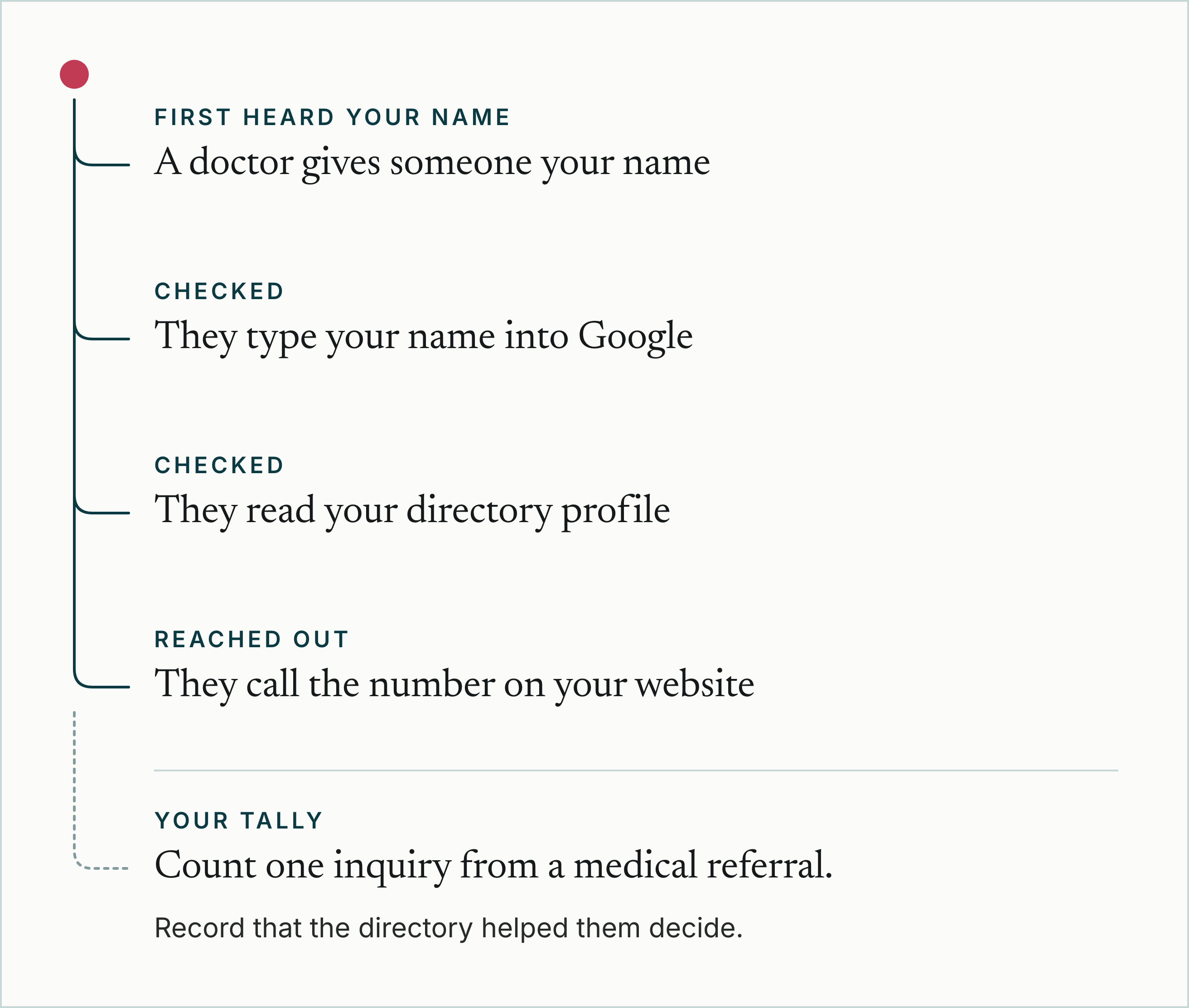
That distinction matters when you have to decide what to keep paying for. Canceling a profile because nobody contacted you through it could remove the page people used to check your fee. Crediting every website inquiry to Google could lead you to overlook the doctor who keeps putting your name into circulation.
In an ordinary intake conversation, you can offer two optional questions. Where did you first hear my name? Was there anything you checked before you reached out? Accept "I don't remember." Tally the answers by broad source. Leave names, diagnoses, and personal stories out of that tally.
In the doctor example, count one inquiry from a medical referral. If the person mentions the directory, record that it helped them decide. If someone can't remember the source, leave it as unknown.
Keep a count of booked and attended first visits, too. At one university training clinic studied by Krendl and Lorenzo-Luaces, nearly 60% of the 264 people who contacted it never scheduled an intake. Some needed care the clinic didn't offer. Others had to wait for space. That clinic's experience shows why even a good referral can end before anyone gets an appointment.
Why a Fast Reply Matters
Delay loses people before the first visit. At one community mental health center, each day of delay before a first visit lowered the share of appointments kept. The drop was steepest in the first week, Gallucci and colleagues found. In another clinic, 9% missed a first assessment booked within a week. When it was a month out, 28.6% missed it, Zhang and colleagues reported.
Before opening, try leaving a message on your practice number and answering it as you would on a working day. If you see clients until six, when can someone expect a call back? Tell them in the greeting. If several people call and nobody books, check what happened after the phone rang before paying for another listing.
Unanswered lines are common. In the JAMA Health Forum study of insurer directories, 61.3% of 5,822 calls got no usable answer. Most often, callers reached only voicemail or an automated system. In a 2022 national poll, 18% of adults who got mental health care said providers they contacted never got back to them.
People often contact several therapists at once. Tufts tells students to call multiple providers, because many may be full, and Wake Forest suggests at least two. In the APA's 2025 survey, 40% of psychologists had a waitlist. Your openings this week help only if people hear back quickly.
Write the Answer You'll Take Into Opening Week
Try writing your prediction before you open.
I have room for [number] new clients. I expect people to hear about me through [source], because [something I've observed]. That source can start [when]. The first thing I can check is [action].
Here's how a part-time therapist might fill it in.
I have two evening openings for grief counseling. Two former colleagues have already asked whether I see adults after work. They can share my details as soon as I give them my hours, fee, and number. I'll ask callers where they first heard my name and whether those hours work for them.
Name a second possibility in case your first guess is wrong. For this therapist, it might be a local bereavement organization that keeps a list of private-pay clinicians. A call to whoever updates it would establish whether families use it and how to be included.
Using Your Answer in a Private Practice Business Plan
If you're writing a business plan, this answer becomes its marketing section. The Small Business Administration's guide says that section should describe how you'll attract and retain customers. You'll draw on it again when you make financial projections.
For a therapy practice, the section can follow five parts.
| Part | What to write |
|---|---|
| Sources | The two or three people, groups, networks, or directories you expect to send clients, by name. |
| Timing | When each can start, using the credentialing and listing times above. |
| Numbers | How many new clients a month keep your caseload steady, using the arithmetic above. |
| Costs | What each source takes: your time, a directory's monthly fee, or an ad budget. |
| Check | How you'll ask where each client first heard your name, and when you'll read the tally. |
Here's how a newly licensed clinical social worker offering insurance-based telehealth might write it.
My first clients will come from the two insurance networks most people in my state use, and from each network's member directory. I'll apply five months before I open, since some plans publish up to 90 days for credentialing. If clients average 12 visits, keeping 25 weekly visits steady takes about nine new clients a month. I'll record which network each new client came through.
Your financial projections build on these numbers. If you'll take insurance, count in-network income from each plan's effective date. Shorter work needs more new clients. A practice offering evaluations or brief services starts over with nearly every client.
If You've Launched and Inquiries Are Still Quiet
You may already have a directory profile, a website, and colleagues sharing your details. A quiet inbox leaves important questions unanswered. Has anyone encountered your details? Could they use the appointment you offer? Can they reach you through the contact method shown?
Ask a colleague or intake coordinator whether recent requests matched the appointments you offer. If they shared your details, check the page or number they used. If they haven't had a suitable request, record that too. Use what you can observe to decide what to check next.
| What you observe | What you can check next |
|---|---|
| Nobody has called. | Can you find the listing under the right filters? Has the colleague had occasion to share your details? |
| The group practice receives inquiries, but few reach you. | Ask how callers are matched to clinicians. Check that intake staff have your current hours, payment details, and scope of practice. |
| People call and repeatedly ask about cost. | Open the exact page they received. Can they see the fee or plan information before contacting you? |
| People want to book, but their schedules clash with yours. | Ask which times they need. Decide whether you can change an opening or should describe your hours earlier. |
| A colleague's referrals have led to first visits. | Ask what prompted them to think of you. That detail may help another colleague recognize the same need. |
If you're deciding when to open or which hours to offer, take your prediction back to your plan for starting a private practice.
After your first new client arrives, write down how they actually found you. Then ask yourself which part of that introduction could happen again. That's where to start looking for your second client.
Questions About Getting Your First Therapy Clients
How long does it take to get credentialed with insurance companies?
Plans that publish a figure give 45 to 90 days from a complete application. Anthem Blue Cross in California says 45 days, Blue Shield of California 45 to 60, and Evernorth up to 90. For counselors and marriage and family therapists, CMS says a clean online Medicare application is generally processed within 15 calendar days. In-network appointments start from the effective date the plan gives you.
Do you need Headway, Alma, or another platform to take insurance?
No. You can credential with each plan directly and hold the contract in your own name, or stay private pay. Platforms quote faster credentialing. In return, the insurer contract, part of the rate, or the inquiry can stay with the platform. We recommend none of them.
What goes in the marketing section of a private practice business plan?
The SBA says the marketing section should describe how you'll attract and retain customers. For a therapy practice, name the people, networks, and directories you expect to send clients. Add when each can start, the new clients you need each month, what each source costs, and how you'll track sources.
Can you take clients with you when you leave a group practice?
It depends on your agreement and your profession's code. Some agreements include a nonsolicitation clause, and the codes differ. The ACA code lets counselors refer an agency's clients to their own practice only where its policies explicitly allow it. The NASW code asks departing social workers to tell clients their options, with each one's benefits and risks.
How many clients does a private practice therapist see a week?
Heard's 2026 survey put the median solo caseload at 18 clients a week. Most solo owners in SimplePractice's 2025 survey scheduled 15 to 24 sessions a week. Counting part-time practices, SimplePractice's platform data put the median solo clinician near 11 sessions a week.
How long does it take to build a private practice?
No study we found measures how long a new practice takes to fill. Figures that circulate online, such as 6 to 18 months, come without a source. Credentialing alone takes 45 to 90 days at plans that publish a figure. In Heard's 2026 report, revenue grows from $24,117 in the first year to over $100,000 at ten years.
Is Psychology Today worth it for a new practice?
It puts you where people search. In our October 8, 2026 study, it appeared in Google's top 10 for 267 of 300 therapist searches. In Heard's 2025 survey, 35% of therapists named it their most common source of new clients. It costs $29.95 a month with no contract. For your practice, the answer shows in how many inquiries name it.
What is the fastest way to get therapy clients?
The sources that start fastest are directories and people who already know your work. Medicare enrollment is quick for clinicians who qualify. Plans that publish a figure take 45 to 90 days, and search usually takes months. Whatever the source, call people back the same day.
Figures You Can Cite
For a talk, a class, or the marketing section of a business plan. Quote each figure with its source and date.
| Figure | Source |
|---|---|
| US adults who got counseling or therapy from a mental health professional: 9.5% in 2019, 14.0% in 2024 | CDC, NCHS data brief 380 and data brief 564 |
| Psychologists with no openings for new patients: 65% in 2021, 46% in 2025 | American Psychological Association, 2025 practitioner survey |
| Practitioners who get clients through referrals or word of mouth: 83%; through online directories: 82% | Heard, 2026 survey of 1,950 practitioners, every channel used |
| Therapists naming referrals or word of mouth as their most common source of new clients: 38%; naming Psychology Today: 35% | Heard, 2025 survey of 3,229 therapists, one answer each |
| Recent therapy patients who looked for a therapist on their insurer's website: 40%; who asked a doctor: 32% | Delboy and Michaels, Psychoanalytic Inquiry, 2025, US survey of August 2023 |
| Referred primary care patients who kept a same-day first visit: 82%; a first visit more than 30 days out: 29% | Pace and colleagues, Annals of Family Medicine, 2018 |
| Calls with a clear outcome to an insurer's listed psychiatrists and psychologists that met a directory error: 55.6% | Haeder and colleagues, JAMA Health Forum, 2026 |
| Credentialing time at plans that publish one: 45 to 90 days from a complete application | Anthem Blue Cross (California), Blue Shield of California, and Evernorth, November 2026 |
| Medicare processing of a clean online application from a counselor or marriage and family therapist: generally within 15 calendar days | CMS enrollment FAQ |
| Google searches for a therapist with Psychology Today in the top 10 organic results: 267 of 300 | Credible by Design, study of October 8, 2026 |
| Practice websites that didn't say whether they were taking new clients: 2,705 of 3,393 | Credible by Design, study of October 8, 2026 |
| Clinicians in their first year on SimplePractice who were open to new clients: 92.1% | SimplePractice, 2025 report |
Heard's 2025 and 2026 figures answer different questions: one top source each in 2025, and every channel used in 2026. Quote each with its question.
To cite this guide: Charles Ivia, "How to Find Your First Therapy Clients in Private Practice," Credible by Design, November 17, 2026.
How We Researched This Guide
Charles Ivia wrote this guide for Credible by Design. We build websites and look after search and listings for therapy and private healthcare practices. We aren't clinicians, lawyers, or billing specialists, so we quote each official or company source and link it.
We read every source on November 17, 2026. Prices and terms change, so check the current page before you sign anything. Our own figures come from our October 8, 2026 study of what Google and ChatGPT showed people looking for a therapist. We also read clinicians' own accounts of their first clients, in podcast interviews and on Reddit.
No study we found follows new practices to their first clients. The surveys above count the channels practices use or the places patients recall looking. If something here is out of date, email charles@crediblebydesign.com and we'll check it.
Opening a practice? We take care of the technical side, from the website to its listings, so you can focus on therapy. Book a 30-minute call and tell us when you open.


